
How our weather advice influenced D-Day and Operation Overlord
Weather information relating to D-Day and Operation Overlord
D-Day, was initially planned for 5 June 1944. In spite of meticulous planning surrounding all other aspects of the invasion the commanders could not control the weather and for advice on this they looked to a team of meteorologists led by Group Captain J. M. Stagg. Born in 1900 Stagg had joined the Meteorological Office as an assistant in 1924. In 1932/33 he led the British Polar Expedition of Arctic Canada and in 1939 he was appointed to the role of Superintendent of Kew Observatory.
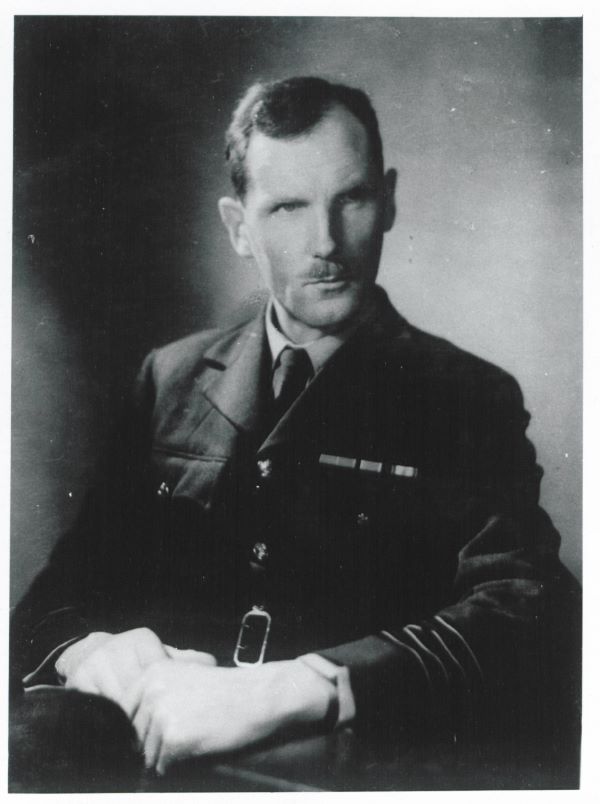
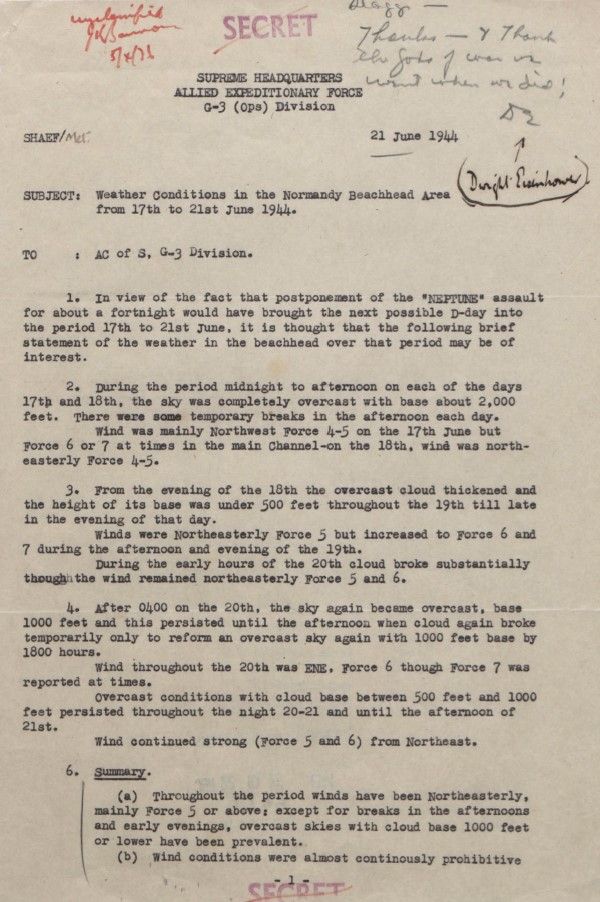
Stagg was appointed Chief Meteorologist to SHAEF in November 1943 to co-ordinate 'the meteorological arrangements for disseminating weather information and advice to the naval, army, and air forces, US and British under the Supreme Allied Commander's control. He acted as chief Meteorologist to General Dwight D. Eisenhower and let a team of forecasters representing the Met Office, the Royal Navy and the US Air Force. Meteorologists from the RAF listened in to ensure they were briefing in continuity with the forecast.
Stagg had a challenging task. UK meteorologists used synoptic forecasting techniques, comparing observations over previous hours and days and using knowledge of the weather and climate of the British Isles to create a forecast. Irving Krick, lead forecaster for the US Air Force, used the Analogue technique, a form of pattern matching, looking at previous weather situations at the same time of year to predict the most likely outcomes. This was a method which worked well in continental climates but was much harder to apply with success to the British Weather. As a result the forecasting teams differed widely on the forecast for D-Day.
Early June 1944 was very unsettled, with a series of unusually low pressures and frontal systems approaching Europe from the Atlantic and rendering forecasting extremely difficult. Despite the pressure Stagg advised that the weather on 5th June, would be too poor and as a result General Eisenhower deferred the invasion. A momentous decision which risked revealing the D-Day secret. Stagg and his teams then had to decide if the weather on 6th June would be any better.
His diary indicates the pressure he was under and includes the line ‘I am now getting rather stunned, it is all a nightmare’. Stagg was well aware that the lives of thousands of young men and the fate of the allied war effort rested on his advice in the decisions to postpone the invasion on the 5th June and to proceed on the 6th. His diary entry early on 5th June states ‘final and irrevocable decision, whatever the outcome, the decision is taken’ and in relation to the praise he received for his work it also reads ‘he should wait until he see’s how things go’
Despite very marginal conditions Stagg advised of a narrow 'weather window' for the operation to go ahead on 6th June. President Truman later said it was "probably the only day during the month of June on which the operations could have been launched” and when, as US President, Eisenhower was questioned on how the Normandy invasion had been so successful he replied ‘because we had better meteorologists than the Germans’.
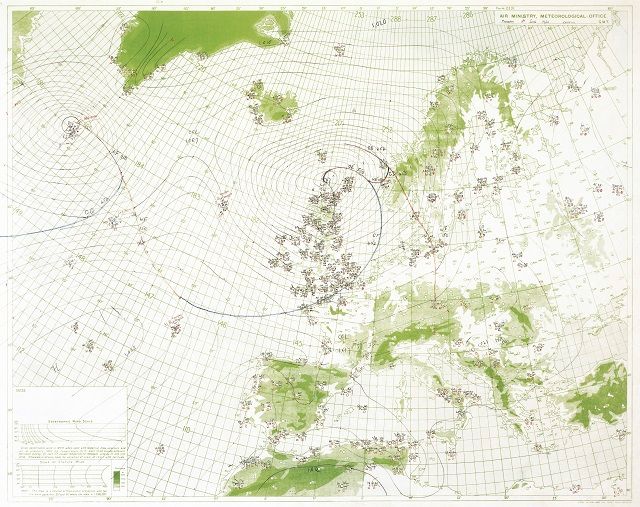
Charts in the Met Office National Meteorological Archive in Exeter reveal that the allies had cracked the German Enigma code thus allowing the D-Day forecasters access not only to observations from Allied observers and reconnaissance flights but also to all the German meteorological observations.
Comparison of the synoptic charts held in the Met Office archives and the archives of Deutscher Wetterdienst clearly shows this placed the Allied forecasters at a significant advantage over the German forecasters in terms of being able to spot a suitable weather window for the invasion. The allied charts contain a wealth of observations from across both the UK and Europe and also some observations from the Atlantic, the area from with the D-Day weather would come. By contrast the German charts reveal that they had been unable to crack the Allied codes and as a result there are virtually no observations for the UK and surrounding waters.
Having access to this additional data gave the allied forecasters sufficient information to be able to plot the location and movement of the low pressure and cold front which forced the landings to be moved from the 5th to the 6th, and the ridge of high pressure which enabled them to predict better weather for the 6th with far greater accuracy than their German counterparts. As a result Stagg was able to advise that conditions on the 6th June would be marginal but sufficient to launch the invasion and in so doing the D-Day forecasters made perhaps the most important forecast in history.
After the war Stagg worked as Director of Services at the Meteorological Office until 1960. For his services over the D-Day period he was appointed an Officer of the US Legion of Merit in October 1945 and was appointed Companion of the Order of the Bath (CB) in the 1954 New Years Honours. He was elected Fellow of the Royal Society of Edinburgh in 1951and President of the Royal Meteorological Society from 1959 to 1961. He died in 1975.
A range of D-Day related materials from our collection including the complete 1944 Diary of James Stagg, have been scanned and can be accessed through our Digital Library and Archive.
Daily weather reports for 1944 in the Digitial Library & Archive.
|
Met Office |
German (DWD) |
|---|---|
Copyright Guidance on German Charts
The German charts have been kindly provided by DWD. Please address all enquiries regarding publication to bibliothek@dwd.de
All information originating from the Met Office is subject to Crown Copyright and is available under the terms of the Open Government Licence