
A weather forecast begins a long way before expert meteorologists get their hands on the latest weather modelling. It starts with something that underpins all of meteorology; data.
The Met Office is a data-led organisation, drawing on observations from around the world to aid in the production of weather forecasts, provide crucial validation for meteorologists, as well as give vital long-term context in a changing climate.
Met Office observations come from a range of sources, from satellites to weather stations and weather balloons. But one – often unseen – piece of the observations puzzle can be found bobbing around in remote parts of the waters around the UK. That’s referred to as the Ocean Data Acquisition System (ODAS), or a weather buoy to the uninitiated.
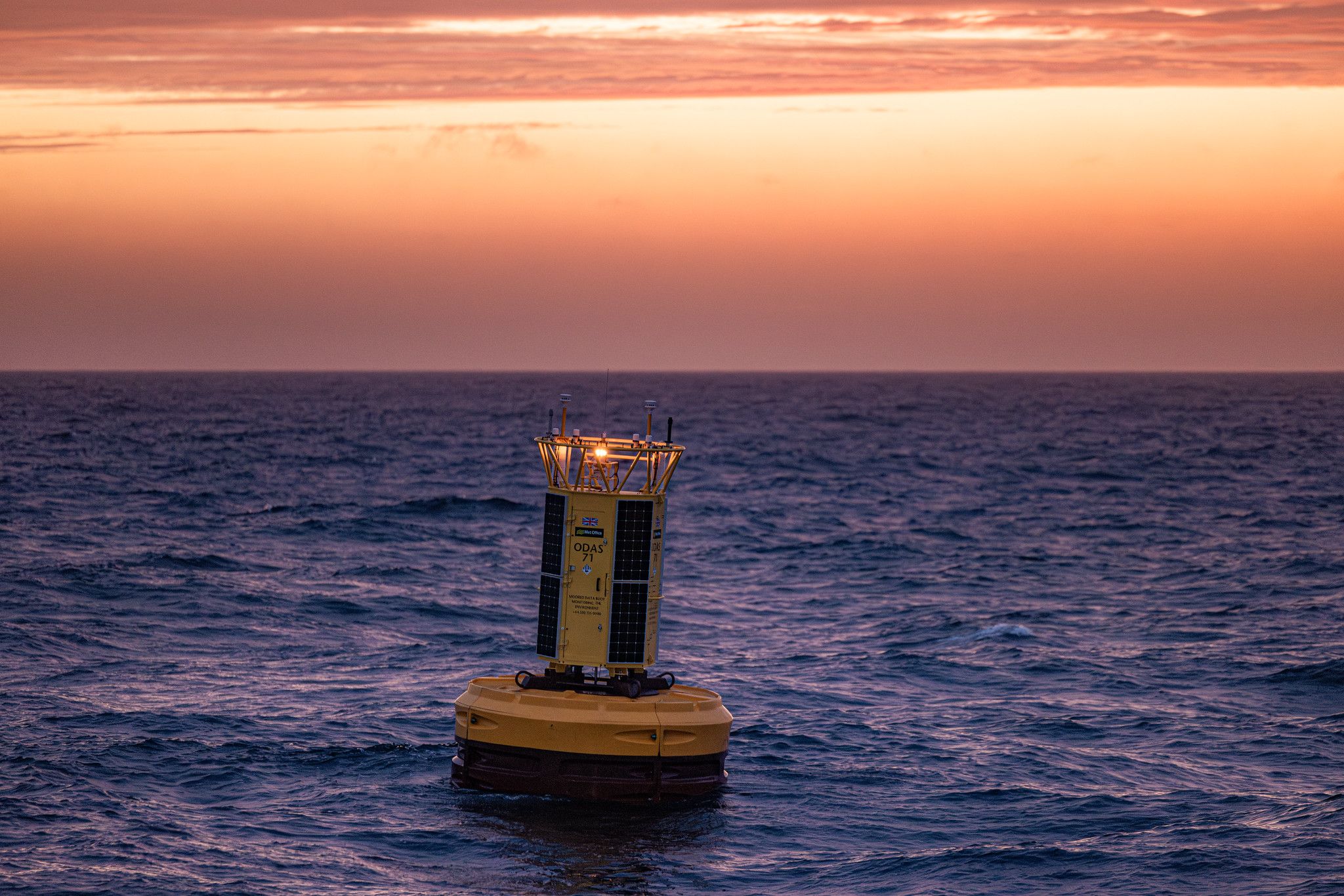
ODAS buoy (Image: NOC)
Servicing at sea
Earlier this year, the Met Office partnered with the National Oceanography Centre (NOC) to provide access to RRS Discovery, a highly capable royal research vessel designed to withstand extreme sea states and deploy cutting-edge technology in the open ocean.
Met Office engineers worked alongside RRS Discovery’s experienced crew servicing, repairing and redeploying ODAS buoys stationed in the southwest approaches near the UK, France and Ireland.

RSS Discovery at sea (Image: NOC)
That work demands more than a capable ship: it requires expert navigation and dynamic positioning, advanced thruster systems that hold the vessel perfectly stationary while heavy equipment is worked over the side, as well as technical teams who manage and deploy thousands of specialised instruments at sea, turning scientific concepts into real-world data.
This vital work is a part of efforts to ensure a continuous data stream from marine observation sites. Met Office engineers, aboard the RRS Discovery, took part in a nine-day deployment at sea, visiting four sites: in the Celtic Sea between Ireland and the UK, west of Ireland, further south in the Atlantic, and near the coast of Brittany, France.
The trip was part of a routine – but often unseen – part of the Met Office’s work. Marine engineers visit buoys at sea and undertake a rigorous process to ensure continuity of vital data from these remote locations.
“What we’re doing is safeguarding some key data that forecasters use to predict the weather,” said Alex Collins, Met Office Marine Systems Operations Engineer.
“We aim to visit each marine site at least once every two years to ensure they’re still fit-for-purpose and resilient enough for the conditions they’re in.”

ODAS buoy on board the RSS Discovery (Image: NOC)
ODAS buoys are a key part of the observational network that feeds into complex calculations made on the Met Office supercomputer to help meteorologists develop the weather forecast.
In addition to its use in producing the forecast, data from buoys can provide vital early evidence of impending weather systems arriving, helping meteorologists finetune their predictions for the hours and days ahead.
Alex added: “We consider these buoys a bit of a ‘western shield’ for weather coming towards the UK. They’re one of the earliest signs of poor weather coming towards us.”
Engineering quality at sea
Continuous and consistent data is the key for all Met Office observations. For weather buoys, ensuring this quality of data requires forethought, planning and a dedicated crew on the ground.
The servicing process involves a multi-step process by the Met Office team to ensure the buoys remain functional, but also that they’re continuing to provide accurate data.
“We inspect the buoys to ensure there’s no damage or entanglements, we check the equipment and the sensors, calibrating measurements with the teams based in Exeter,” said Alex.
“Every bit of kit that returns to sea will either be brand new, refurbished or recently calibrated.”
It’s this approach – inspection, calibration and replacement – that ensures the integrity of ocean buoy data until the next inspection.
While some equipment will invariably become compromised in some way over time, the design of the buoys builds in some resilience, as Alex explained.
He said: “We build as much redundancy as possible into these systems, with a primary and secondary source for most of the data. The idea is that users of the data, which can include marine cargo and fishermen, won’t ever see a drop in data availability, because any gaps are being filled by the backup system.”
https://www.youtube.com/watch/3-9sRwXdLhQ?start=0Measuring the weather and the sea
The ODAS buoys at sea collect a variety of observations useful for meteorology, including wind speed and direction, temperature and humidity, pressure, wave heights and even sea surface temperatures.
“These buoys are providing ground-truth observations that simply wouldn’t be available without our work,” said Alex.
“What’s interesting now is that, because collecting this data is very repeatable and consistent, we’ve got almost 40-years of data from some of these sites that can be useful in helping to assess how the ocean is responding to climate change.”
Advancing scientific understanding
The trip was facilitated by the National Oceanography Centre (NOC), who exist to deepen understanding of the ocean to address some of the most urgent environmental and societal challenges of our time.

RSS Discovery at sea (Image: NOC)
Eleanor Darlington, Deputy Director of Research Infrastructure, NOC, said: “The UK has some of the best ocean research infrastructure in the world. The NOC operated research vessels, together with specialist crew, technicians & equipment enables the UK Met Office to maintain the UK buoy network. Data provided through the strategic alignment of research infrastructure delivers immediate societal benefits through improved weather forecast accuracy.”
Met Office and NOC also welcomed volunteers from MARINElife on board the vessel, carrying out a scientific survey on the marine life spotted in parts of the ocean that often have precious-little nature-based observations.
Tom Brereton is the Science Director at MARINElife. He said: “The UK has limited knowledge of the range and abundance of marine wildlife, including whales, dolphins and seabirds in our seas. As a charity MARINElife aims to plug these gaps, so having access to some of the least studied waters in the UK was valuable.
“We are grateful to have been able to have two MARINElife research volunteers on this voyage, which has provided valuable data and potentially new insight into the movements and migrations of species into the UK. Climate change is affecting marine wildlife and it is vital to obtain observations of the changes of iconic species using our oceans.”
Continuing to safeguard the future
Maintaining the quality of all Met Office observations is an ongoing process.
The next Met Office ODAS buoy trip will take place later this year, this time looking at the buoy sites further north around the UK.
The continuous work – maintaining a complex and hard-to-reach observations system – ensures that data underpinning forecasts remains robust, accurate and reliable.
In remote parts of the ocean where few observations exist, these buoys – and the engineers that maintain them – are providing a crucial foundation for weather and climate monitoring.
In an age where information is widely available, it is this careful, consistent approach to observations that underpins forecasts people can trust.

ODAS buoy deployment (Image: NOC)