


WCSSP India
The Weather and Climate Science for Service Partnership (WCSSP) India is a collaborative science initiative between the UK and India.
What is the Weather and Climate Science for Service Partnership (WCSSP) India?
The Weather and Climate Science for Service Partnership India (WCSSP) India is a research project building and harnessing strong, sustainable science and innovation partnerships between the UK and India.
It is advancing scientific understanding and modelling capabilities that can be translated into services, to protect lives and livelihoods around the world.
The WCSSP India project is part of our Weather and Climate Science for Services Partnership (WCSSP) programme. The programme is funded through the UK government’s International Science Partnerships Fund (ISPF), with the Met Office serving as a delivery partner.
Download our WCSSP India 2025 infographic to learn about the difference the project is making.
Who is involved in the project?
WCSSP India is a collaborative initiative between the Met Office, UK academic partners and the Indian Ministry of Earth Sciences (MoES). It builds on existing partnerships between the Met Office and MoES institutes including the National Centre for Medium Range Weather Forecasting and India Meteorological Department. It also includes other MoES institutes such as the Indian Institute of Tropical Meteorology, the Indian National Centre for Ocean Information Services, the National Centre for Coastal Research and the National Centre for Polar and Ocean Research.
UK academic partners include the Centre for Ecology and Hydrology, the Health and Safety Executive, HR Wallingford, National Centre for Atmospheric Science, National Oceanography Centre, University of Birmingham, University of Leeds, and the University of Reading.
UK research institutes can find out about research calls and how to get involved in the project on our fund management page.
Why is this research important?
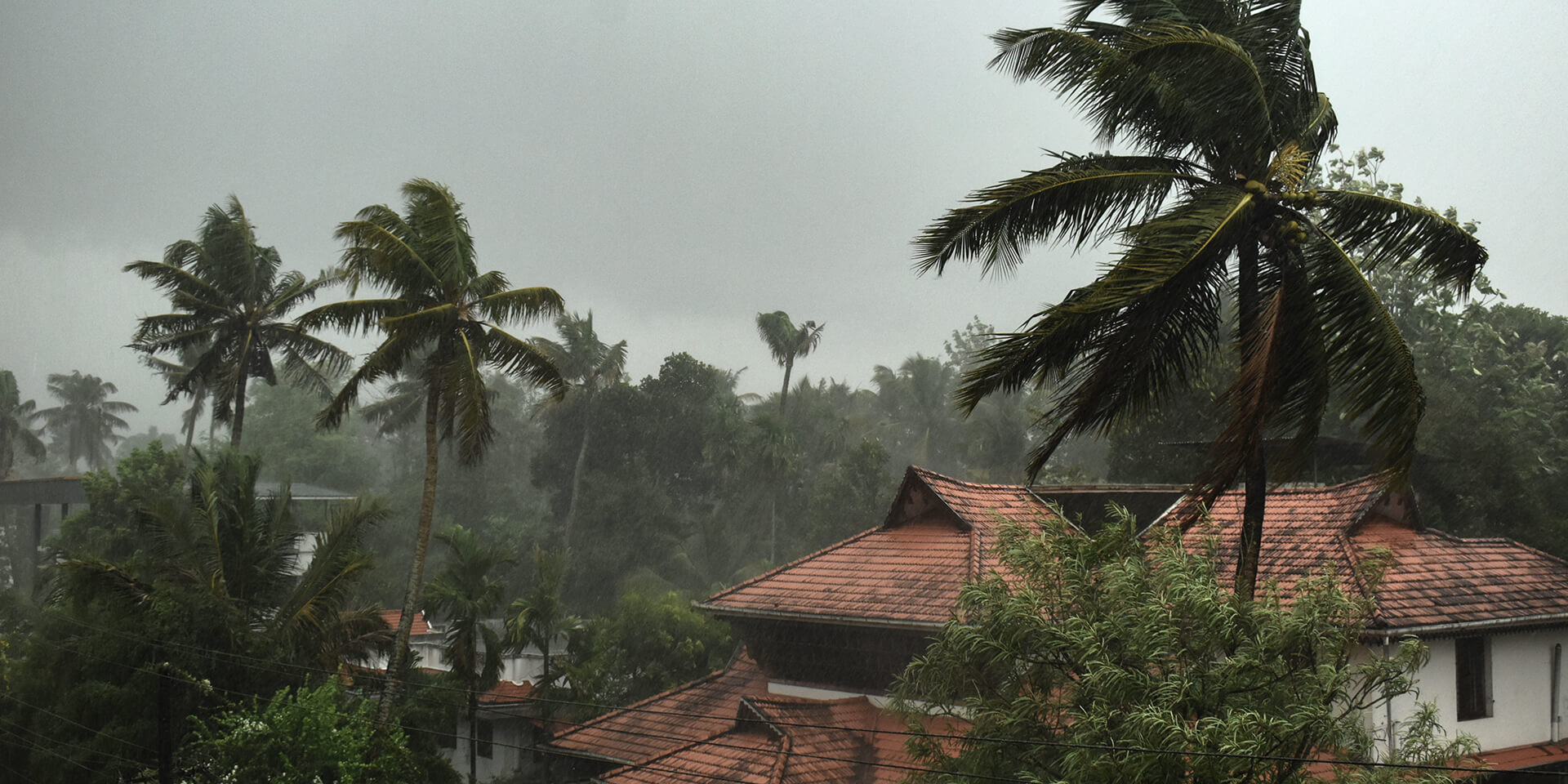
Every year, the Indian summer monsoon generally occurs between June and September and brings heavy rainfall to the region. Around 80% of the annual rainfall in India falls during the monsoon season and many industries such as agriculture rely on this water. Heavy summer monsoons can also cause flooding making it an important weather event to understand.
Around the world, severe weather and climate events such as fog, lightning and tropical cyclones can have significant impacts on the agriculture, energy and transport sectors. WCSSP India is developing the science needed to build improved predictions of weather and climate hazards to support resilient economic development and social welfare around the world.
Research areas
Building and developing new prediction capabilities
WCSSP India is developing cutting-edge computer modelling systems that will contain a more detailed and comprehensive representation of the natural environment. These will provide a foundation for improved predictions of high impact weather. The project has already developed a new tool to help anticipate future periods of flooding and dry spells. The WCSSP programme is exploring the use of this tool to benefit other regions around the world such as Southeast Asia and Brazil.
Evaluating and improving predictions
The project is utilising observations to enhance our understanding of monsoon processes and to evaluate and improve the cutting-edge modelling systems. A range of high impact weather hazards are of interest including tropical cyclones, fog, lightning, heatwaves, droughts and flash floods.
High-impact weather and risk-based forecasting
To deliver improved forecasts, early warning and communication of high impact weather and seasonal events, the project is using new and multi-disciplinary approaches to develop impact-based forecasting methods. This builds on existing tools and infrastructure already in place in India and the UK.
Research grants awarded
We have provided opportunities to conduct research for WCSSP India in various areas including the following:
- Fog – Land, Boundary Layer & Aerosol processes, University of Leeds
- Orographic Precipitation, University of Reading, 2021
- Near-real time and post-event impact data collection and vulnerability assessment from earth observation data, HR Wallingford, 2021
- Flood Hazard Impact Model for India, UKCEH, 2021
- Developing metrics and diagnostics for assessing ocean dynamics, National Oceanography Centre, 2020
- Using satellites for impact and vulnerability assessments, HR Wallingford, 2020
- Novel assimilation methods for coupled atmosphere-ocean prediction, University of Reading, 2020.
Recent project research publications
The project has produced several collaborative peer reviewed studies by scientists from research institutes in the UK and India, including the following:
- Titley et al., Key factors influencing the severity of fluvial flood hazard from tropical cyclones, Journal of Hydrometeorology, 2021
- Keane et al., Biases in Indian summer monsoon precipitation forecasts in the Unified Model and their relationship with BSISO index, Geophysical Research Letters, 2021
- Levine et al., Roles of air–sea coupling and horizontal resolution in the climate model simulation of Indian monsoon low pressure systems, Climate Dynamics, 2021
- Kabir et al., A deep convolutional neural network model for rapid prediction of fluvial flood inundation, Journal of Hydrology, 2020
- Tsushima et al., Investigating physical constraints on climate feedbacks using a perturbed parameter ensemble, Climate Dynamics, 2020.