
Sea ice in the climate system
Arctic sea ice is a sensitive indicator of climate change and changes to the sea ice cover can have potential implications for the Arctic region and beyond.
Found in both the Arctic and Antarctic, sea ice regulates heat exchange between the ocean and atmosphere, supports polar ecosystems, and serves as a sensitive indicator of climate change. Sea ice forms in high-latitude regions where winter darkness and cold temperatures allow the ocean to freeze. Unlike glaciers or ice sheets, sea ice is already floating, so its melting does not directly contribute to sea level rise.
Sea ice composition
Sea ice is composed of blocks of frozen seawater called ‘floes’, which are constantly in motion due to winds and currents. These floes can range from 10 metres to 5 kilometres wide and are typically 0.5 to 5 metres thick. Snowfall accumulates on the ice, increasing its insulating properties. Areas of open water between ice floes are called ‘leads’. Sea ice floes can freeze together and can be broken by collisions or ocean waves. Depending on the time of year and the location, ice floes may float independently from each other or be squashed together to form an almost continuous pack ice cover permeated by cracks and ridges of thicker ice.
Whilst the freezing point of freshwater is 0 °C, the salt forces the freezing point of seawater to be lower. Typically, seawater with a salinity, or salt content, of 35 parts per thousand (or 3.5%) will have a freezing point of around -1.8 °C. Sea ice does not form in a uniform way like freshwater ice and is much more complicated.
Sea ice - seasonal cycle and variability
Sea ice cover varies dramatically with the seasons. As the Earth's surface at the poles warms in summer, more than half the sea ice melts to reveal the open ocean below. Then, as the surface cools in the autumn, the ocean starts to freeze again leading to an increased sea ice cover through the winter months. At least 15% of the ocean is covered by sea ice at some point during the year. In the Arctic, maximum coverage occurs in late winter (February–March), reaching about 15–16 million square kilometres, while the minimum occurs in September, dropping to 5–6 million square kilometres.
The role of sea ice in the climate system
Sea ice acts as both an insulator and a reflector. In winter, it insulates the relatively warm ocean from the frigid atmosphere, slowing heat loss. In summer, its high reflectivity (albedo) bounces solar radiation back into space, helping to keep the polar regions cool.
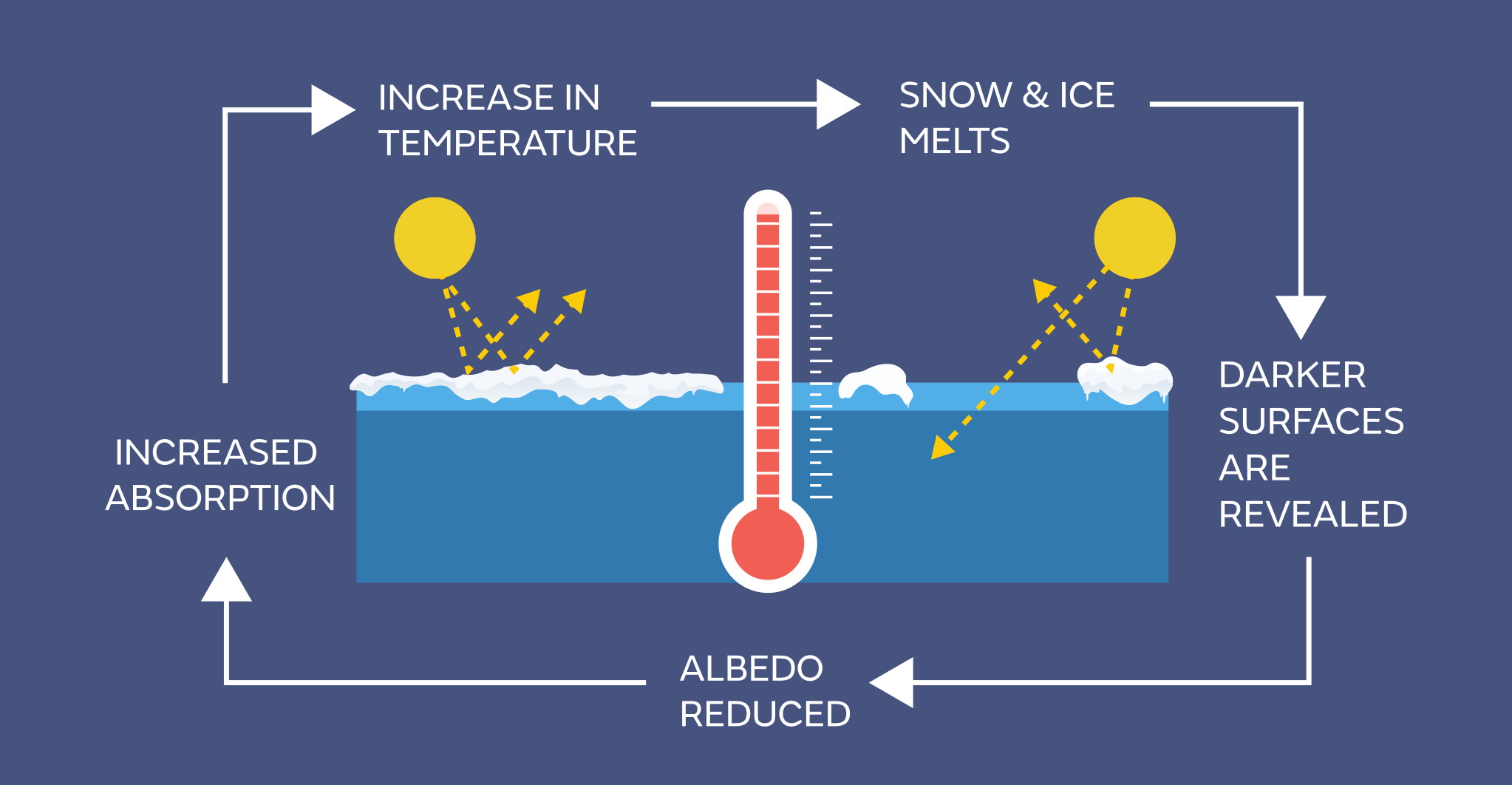
Schematic showing the ice albedo feedback which can lead to amplification of warming in the Arctic.
Observed changes and trends in sea ice
Satellite and in-situ observations over recent decades reveal a significant decline in both the extent and thickness of Arctic sea ice. The summer minimum extent has reached record lows, with the last several decades showing a clear downward trend.
Our sea ice brief archive contains sea ice briefing documents from 2015 onwards.
Factors influencing sea ice variability
Sea ice is influenced by a range of factors beyond seasonal sunlight:
- Wind and storms: Can break up ice, change heat transfer, and bring snow or warmer water.
- Clouds: Reflect sunlight in summer (reducing melt) and insulate in winter (reducing growth).
- Ocean currents: Warm Atlantic and Pacific waters entering the Arctic can melt ice from below.
- Freshwater input: Increased rainfall or river discharge can freshen the surface, affecting ice formation.
Future sea ice projections
Climate models project a continued decline in Arctic sea ice throughout the 21st century, with the summer minimum expected to decrease faster than the winter maximum. Under high greenhouse gas scenarios, the Arctic could become nearly ice-free in summer as early as the 2040s.
Sea ice predictability and research
Predicting sea ice conditions months in advance is challenging due to the strong influence of weather and atmospheric patterns. However, large-scale phenomena like the North Atlantic Oscillation and initial conditions such as ice thickness and melt pond coverage can improve seasonal forecasts.
Sea ice is far more than a passive indicator of climate change; it is an active participant in the Earth’s climate system. Its decline is both a warning sign and a driver of further change, underscoring the interconnectedness of the planet’s atmosphere, oceans, and ecosystems.