
Joint-fourth warmest September on record for the UK
The UK had its joint-fourth warmest September on record in a series which dates back to 1884, according to provisional figures from the Met Office.
Spurred on by late month warmth, which saw the maximum temperature rise as high as 28.1°C on 29 September, the month’s mean temperature for September is provisionally 14.6°C, and slots in as the joint-fourth warmest on record, level with September’s figures from 1949 and 2016.
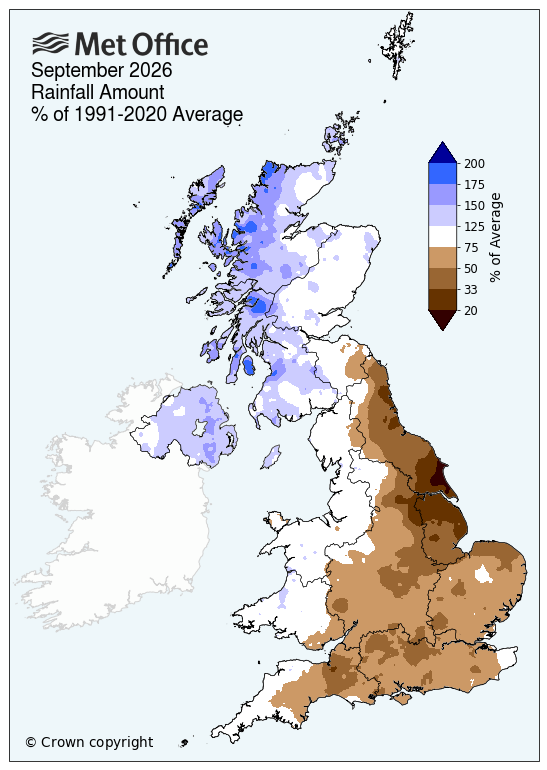
While rainfall amounts were closer to average overall, significant regional differences remain, with parts of southern and eastern England remaining particularly dry.
Anomalous warmth continues
Following provisionally the hottest summer on record, September has continued the recent run of above-average months for mean temperature through much of 2026.
Met Office Climate Information Scientist Mike Kendon said: “Persistent warmth has been the theme of recent months and September is no different. September 2026 was the joint-fourth warmest September on record in the series for the UK with high pressure particularly prevalent in southern areas later in the month.
“While the month itself was unexceptional overall, when putting it into the context of the warm year we’ve had so far, this fits with the general pattern that we’re seeing of more frequent above average temperatures in the UK as our climate continues to change.”
The extent of September’s warmth wasn’t uniform across the UK. Wales reported its joint-sixth warmest September on record, England its third and Northern Ireland its fourth. While still warmer than average, Scotland was just outside its top 10 warmest.
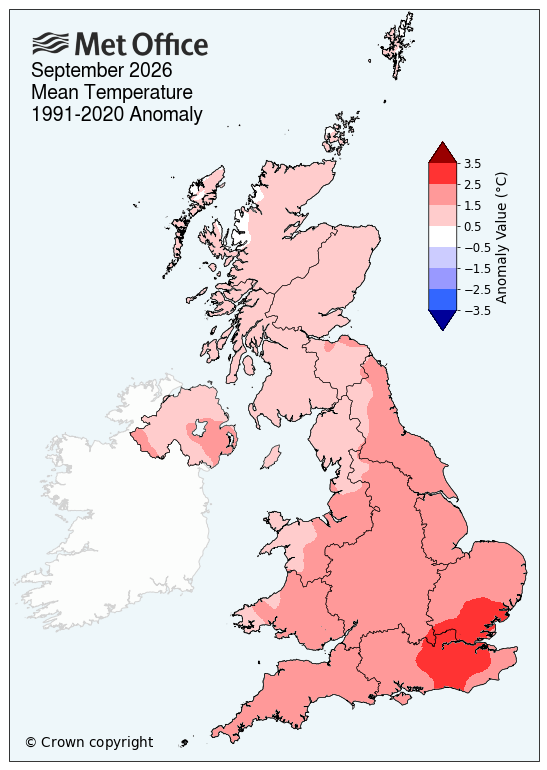
Overnight minimum temperatures were also notably high, with it being the UK’s joint-fourth highest average minimum for the month. For Northern Ireland, it was joint-first, Scotland fifth, England fourth and Wales fourth.
September stayed fairly dry for some
The UK’s near-average rainfall for the month masks significant regional differences.
While Scotland saw over a third more rain than its average for the month, southern England remained relatively dry compared to average – despite some recent rain.
Environment Agency Chief Executive, Philip Duffy, said: “September’s rainfall has been welcome, but a few weeks of unsettled weather is nowhere near enough to reverse the water deficits caused by a dry spring and record hot summer.
“Drought is only over when groundwater, rivers, and reservoirs are back to normal levels – and that will take months of significant and sustained wet weather.
“In the meantime, the situation remains serious with drought-hit areas of England again seeing the least amount of rain over the month. Water supplies are limited and several reservoirs are concerningly low. We still need everyone to use a little less water to speed up the drought recovery and save more for our local rivers, farmers, and wildlife.”
Sun shines for some, but not for others
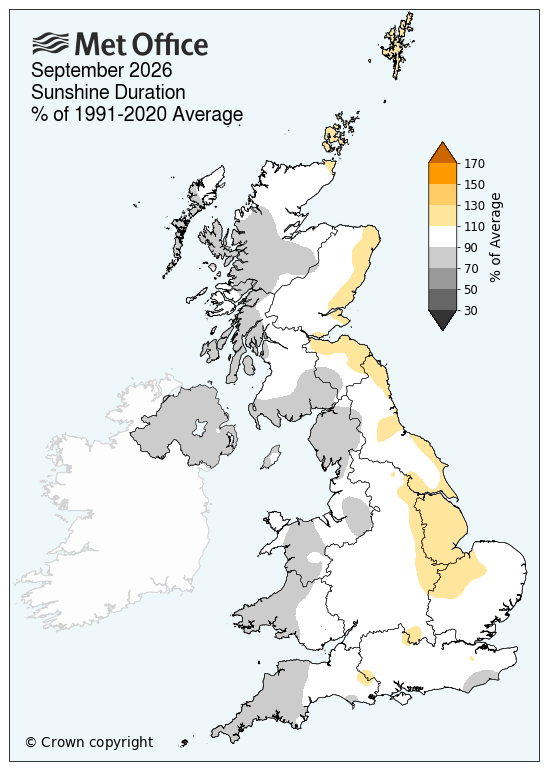
Sunshine amounts were around average for the UK, though Northern Ireland was fairly dull compared to average, albeit not enough to trouble any records.
Provisional September 2026 statistics
|
Provisional September 26 stats |
Mean temp (°C) |
Rainfall (mm/%) |
Sunshine (hours/ %) |
|||
|
|
Actual |
91/20 anomaly |
Actual |
91/20 anomaly |
Actual |
91/20 anomaly |
|
UK |
14.6 |
1.6 |
94.7 |
104 |
124.6 |
98 |
|
England |
16.0 |
2.0 |
44.8 |
65 |
142.7 |
101 |
|
Wales |
14.6 |
1.6 |
112.5 |
101 |
114.8 |
89 |
|
Scotland |
12.3 |
1.0 |
169.0 |
137 |
102.7 |
96 |
|
Northern Ireland |
14.0 |
1.5 |
118.4 |
135 |
92.0 |
81 |
Where does the monthly data come from?
The Met Office’s monthly climate statistics use HadUK‑Grid data to work out county, regional and UK‑wide averages. The dataset takes weather observations from across the country and interpolates them across the UK onto a 1km x 1km grid, covering every part of the UK. Some of these records stretch all the way back to 1836, meaning almost 200 years of weather data.
https://www.youtube.com/watch/MffwvKK1jBE?start=0