
In this blog, Met Office climate scientists Dr Nick Dunstone and Dr Gillian Kay explain how climate modelling can provide context to this summer’s remarkable temperatures.
The Met Office has just released provisional climate statistics showing that summer 2026 was the warmest UK summer on record, based on average temperatures across June to August.
Behind the UK summer average temperature there is a lot of detail, and alongside the headline record the summer was remarkable in many other respects. It was the first year in which every summer month experienced temperatures above 35°C, and the prolonged heat was closely linked to exceptionally low rainfall, contributing to drought conditions across parts of England and Wales.
Unsurprisingly, these conditions have sparked widespread discussion, including claims that "this could be the coolest summer of the rest of your life". In this article, we explore what climate science can tell us about a simple question: just how unusual was summer 2026’s hot day count in today's climate?
To answer this, we can use very large numbers of climate model simulations of our climate, in a method we call ‘UNSEEN’, to explore what is possible in today's climate. As we only observe one sample of what is possible each summer, and this is further compounded by the fact that our climate is warming, UNSEEN allows us to explore the statistics of what is physically plausible.
In a scientific paper we published last year (Kay et al. 2025), we used this method to show that the chance of exceeding 40°C, recorded for the first time in the UK on 19th July 2022, has been rising rapidly over recent decades. Not only that, but the frequency of hot days and heatwave duration have been increasing. As well as peaks in the middle and high 30s, it is the persistence of high temperatures that has made summer 2026 remarkable, as shown in Fig. 1 where we compare this summer to 2022 and the infamous summer of 1976.
This analysis uses gridded observations from the Met Office HadUK-Grid. Together with methodological reasons, this could lead to some small differences between the numbers quoted here and the station-based observations you may see elsewhere.
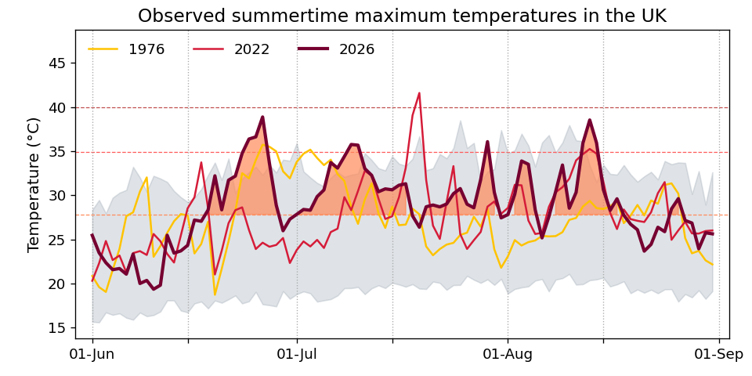
Figure 1: Maximum temperatures reached anywhere in the UK each day of notable summers. The summers of 1976, 2022 and 2026 (coloured lines) are placed in the context of all other summers from 1960 to 2025 (grey shading). Days in summer 2026 above 28°C are shaded in orange. Following Kay et al. 2025.
We can count the number of days above particular temperature thresholds and compare these numbers each summer since 1960, as shown in Fig. 2. We first examine the 28°C threshold as representative of a hot day; three or more consecutive days above this threshold defines a heatwave in a large area of Southeast England.
The observed years (black crosses) reveal that before 2026 the record for the number of 28°C days was still in the 20th century, with both 1976 and 1995 having 41 days (although the warm summers of 2018, 2022 and 2025 have all come close to 40 days in recent years). However, summer 2026 (the black star) has comfortably surpassed this record by adding another 14 days, giving 55 in total.
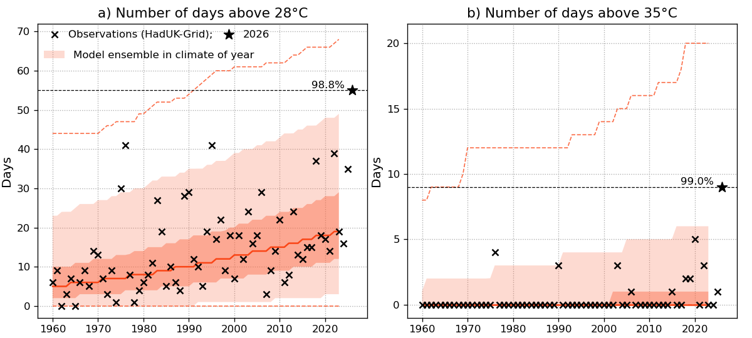
Figure 2: Putting the observed frequency of UK hot summer days into the context of the climate of the time. For the 28°C (a) and 35°C (b) thresholds, the expected frequency of hot days for the climate of each year from 1960 to 2023 is given by the model simulations. Darker shading is the 50% confidence interval, paler shading is the 95% confidence interval, the bold red line is the median and dashed lines the maximum and minimum simulated values. Black crosses show the recorded number of days above each threshold, with summer 2026 represented by a star. We note that the maximum daily UK temperature is most often observed in the climatologically warmer climate of southern England, and so the number of hot UK summer days is often more reflective of conditions experienced in that region than other parts of the UK. Adapted from Kay et al. 2025.
Our climate model simulations provide context for each observed summer, shown by the shaded regions in Fig. 2, by giving an estimate of expected numbers of hot days in that year. This allows us to understand how unusual each observed summer was relative to the climate of the day.
The summers of 1976 and 1995 stand out, falling outside the range containing 95% of simulated summers, the pale shading. This indicates that they were among the most extreme summers expected in the climate of that time. Since 1995 there has not been another summer with number of hot days above the 95% range until this summer. Its 55 days above 28°C is well above the estimated expected number of approximately 20 for the climate of 2026 indicated by the thick red line.
We can also explore the 35°C threshold which is considerably more extreme. Fig. 2b shows that for the first thirty years, 1960-1989, it was only in summer 1976 that temperatures rose above 35°C (on 4 days that summer in fact). By comparison, in the last decade alone we have seen six summers with 35°C days, which is in broad agreement with our UNSEEN estimate that in our current climate we’re approaching a 50-50 chance of seeing at least one 35°C day each summer.
However, as for the 28°C threshold, Fig. 2b reveals summer 2026 is a record event with nine days above 35°C – almost double the previous record set in 2020. Comparing with our UNSEEN estimate suggests that experiencing nine days over 35°C is approximately a 1% chance in any given year under current climate conditions. This is often described as a “1-in-100 year event”, meaning it remains a relatively unlikely event today.
However, this estimate is for the current climate, and it is important to realise that because our climate continues to warm, i.e. it is non-stationary, that we should not expect to wait 100 years to see another summer with nine days above 35°C.
We have illustrated using climate model simulations that our UK summer climate is warming, due primarily to rising global greenhouse gas concentrations, and this is increasing the probability of hot days in the UK. However, whilst this is a strong trend, particularly for the more extreme hot days (e.g. 35°C), a summer with many hot days still requires favourable weather patterns to develop. When these do not occur, then it is still quite possible to have no days over 35°C in a summer, for example as happened in 2021, 2023 and 2024.
The key weather patterns for hot UK days are summarised in Fig. 3 where we show the composite average of all days exceeding 35°C in the observations and in the UNSEEN model simulations. You can see that these show very similar weather patterns, with high pressure in the vicinity (or to the north-east) of the UK and/or low pressure to the west of the UK. These patterns effectively promote southerly, or south-easterly, winds that bring warmer air from continental Europe, northern Africa or the sub-tropical Atlantic.
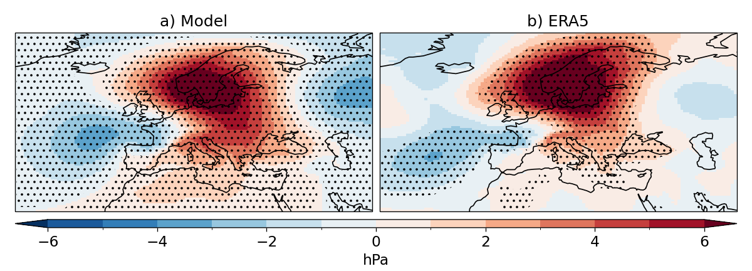
Figure 3: Pressure patterns during the warmest days in the UK. Composite mean sea level pressure anomalies simulated by UNSEEN model simulations (a) and in the observed ERA5 reanalysis (b) for days where temperatures somewhere in the UK exceeded 35°C. Stippling indicates a measure of statistical significance of these patterns. We note that the longer-term weekly and monthly summer weather patterns are also key for producing warm conditions over continental Europe, that can then be a source of air to the UK on its hottest days. Adapted from Kay et al. 2025.
The best way to think about this is that for a given weather pattern we can expect higher temperatures to occur in today’s climate than we would in decades past. Some summers, such as 2026, have persistent weather patterns that are very conducive to repeated high UK temperature days. There are of course other important questions about how the weather patterns themselves will change in our warming climate and this is still a very active area of climate research, including here at the Met Office.
In summary, we have illustrated that in terms of the numbers of hot and very hot days, summer 2026 was an extreme season, at the upper end of what we might expect to see even in our current warmed climate. However, without substantial reductions in global greenhouse gas emissions, summers like 2026 are expected to become increasingly likely in the future.
It is also clear that the UK will need further adaptation of infrastructure to cope with the increasing frequency of hot summers, with 35°C days now expected to occur, on average, almost every other summer. This touches many aspects of society: such as how to effectively cool our homes, workplaces, hospitals and schools; how to minimise the risk of wildfires; how to increase the temperature resilience of energy and transportation networks.
Kay, G., Dunstone, N., Smith, D.M., Brown, S.J., Kent, C., Lockwood, J.F. and Scaife, A.A. (2025), Rapidly increasing chance of record UK summer temperatures. Weather, 80: 268-276. https://doi.org/10.1002/wea.7741