
WCSSP South Africa
The Weather and Climate Science for Service Partnership (WCSSP) South Africa is a collaborative initiative between research institutes in the UK and South Africa.
What is the Weather and Climate Science for Service Partnership (WCSSP) South Africa?
The Weather and Climate Science for Service Partnership South Africa (WCSSP) South Africa project is a scientific collaboration that aims to build and strengthen equitable partnerships amongst the UK and South African weather and climate science and services communities, to inform actions and policy that reduces risk, safeguards lives and livelihoods, and promotes resilience, economic development, and social welfare in a changing climate. The project achieves this through enabling collaborations that advance innovative science and services development, across weather, seasonal, and long-term climate change timescales.
The project provides grants to support researchers from the UK climate science community in their work with South African research institutes.
WCSSP South Africa is part of our Weather and Climate Science for Service Partnership (WCSSP) programme. The programme is funded through the UK government’s International Science Partnerships Fund (ISPF), with the Met Office serving as a delivery partner.
Download our WCSSP South Africa 2025 infographic to learn about the difference the project is making.
Who is involved in the project?
The project is a partnership between the Met Office, research organisations in the UK, and a range of institutes in South Africa:
- South African Weather Service (SAWS)
- Alliance for Collaboration on Climate & Earth System Science (ACCESS)
- Council for Scientific and Industrial Research (CSIR)
- Agricultural Research Council (ARC)
- Global Change Institute (GCI) at the University of the Witwatersrand
UK research institutes can find out about how to get involved in the WCSSP programme on our fund management page.
Strengthening research collaboration
The project builds on an existing partnership between the Met Office and SAWS, which has evolved over the past decade to support SAWS advance their weather forecasting capabilities. SAWS is the only national meteorological service on the African continent to be part of the Momentum Partnership, a global scientific framework that fosters collaborative working on a range of modelling and science to improve weather and climate prediction.
Why is this research important?
Extreme weather and climate change are of great concern for South Africa. In the coming decades all regions of South Africa are expected to become hotter, sea-levels are rising, and changing rainfall patterns are expected, with drier conditions projected for the southwest region. South Africa is also experiencing more extreme weather, leading to damaging floods, heatwaves and droughts. Working collaboratively to address the challenges presented by extreme weather, climate variability, and climate change, will help safeguard lives and livelihoods across the country and wider southern Africa region. The findings of the research, and methods developed to advance different scientific frontiers, will also support weather and climate science and services in the UK and around the world.
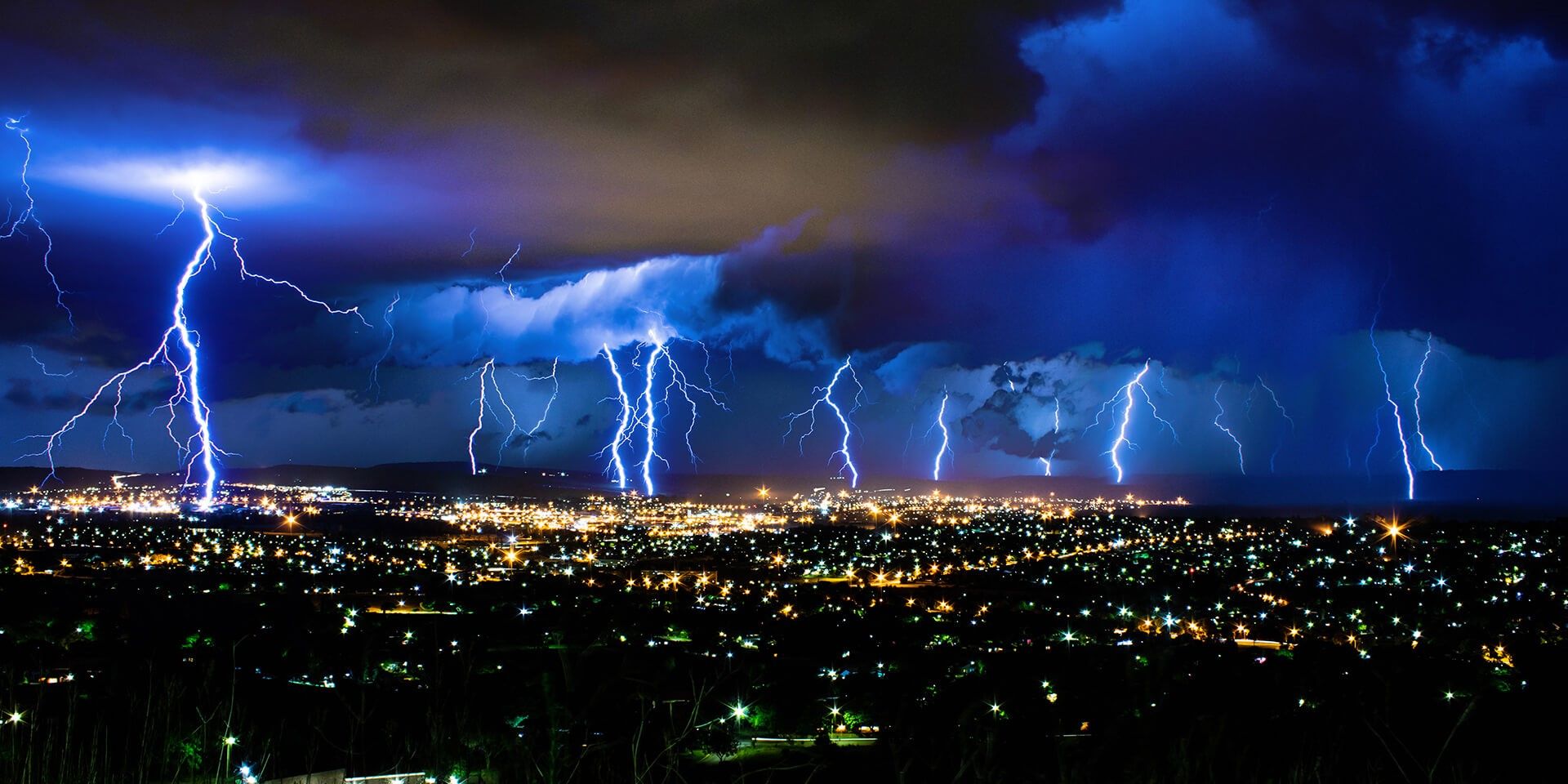
Lightning storm over Newcastle, South Africa
Current research areas
Enhancing datasets and modelling across timescales
Ongoing research is focusing on the differences in the representation of important physical processes and hazards across model versions, domains, and resolutions to assess the added value of convective-scale simulations for different applications. Work is developing tools and diagnostics to evaluate model simulations across weather and climate timescales.
Research is also capitalising on AI and ML advances to enhance the efficiency of data rescue and analysis (to support historical climate reconstructions and analysis), create large ensembles of downscaled climate data, and examine potential applications to extreme event attribution.
Finally, work continues to align with the Momentum Partnership, sharing expertise and capabilities to support SAWS in numerical weather prediction.
Weather and climate processes for impact science and prediction
Collaborations between UK and South Africa partners are focusing in key areas, including climate and health, modelling of drought and water systems. E.G., developing capabilities for the Joint UK Land Environment Simulator (JULES)), and understanding impacts associated with extreme weather and climate events.
Research is focused on priority hazards (drought, flooding, heat, wind, and marine hazards) and sectors (agriculture, coastal, energy, health and water) to explore new impacts tools and methods, bridging weather and climate data with vulnerability and exposure data.
Transdisciplinary learning and risk-based services
Research is focused on understanding and articulating needs, priorities and opportunities for weather and climate services. In addition, innovative approaches are being applied to co-develop new services and information that supports decision-making across weather and climate timescales and societal contexts of relevance.
Given the longstanding partnership between SAWS and the Met Office since the inception of the project, and the role of SAWS as the mandated national meteorological service in South Africa, the project has a strong emphasis on the development of services delivered by SAWS – e.g., marine and energy services.
Broader service development is focused on key hazards and sectors, and there is strong alignment and collaboration with other projects and initiatives involving WCSSP partners.
- Read our 2025 Science Highlights Report [PDF document, 40 pages]. This details key project achievements and events during 2025, with examples chosen to highlight progress across underpinning science and service development.
Research grants awarded
WCSSP South Africa is supporting various research grants across the priority science areas, including the following:
- Attribution of extreme Weather for southern African ImpacTs (AWAIT) - University of Oxford, 2025-2028
- Water Availability duRing Drought (WARD) - UK Centre for Ecology and Hydrology (CEH), 2025-2028
- South African impact‑based Forecasting and Early warnings (SAFE) - HR Wallingford, 2025-2028
- Advancing rip current forecasts for beach locations across South Africa – CMAR, University of Plymouth, 2024-2027
- DR-Africa: Data Rescue Africa – University of Southampton, 2024-2027