
Northern Ireland sees wettest January in 149 years as 2026 gets off to a wet and windy start
January 2026 was a notably unsettled month for many across the UK, with persistent spells of heavy rain and strong winds.
Provisional Met Office statistics show that Northern Ireland experienced its wettest January in 149 years – and second wettest on record – while southern England also recorded its sixth wettest January since the series began in 1836. The UK overall saw above-average rainfall, slightly below-average temperatures, and sunshine levels close to average for the month.
A very wet month for many
Rain fell frequently throughout January as a series of Atlantic low-pressure systems brought repeated rounds of wet and windy weather. This came off the back of above-average rainfall in both November and December, meaning the ground was already sensitive to rainfall.
Storms Goretti, Ingrid and Chandra each contributed to a month dominated by saturated ground, flooding and unsettled conditions. Some communities continue recovery operations as February begins, with warnings for rainfall and snow in the current forecast and another unsettled week ahead.
Met Office science manager Dr Amy Doherty said: “January has been exceptionally wet because we’ve seen a very persistent Atlantic weather pattern. A strong jet stream has repeatedly steered low-pressure systems towards the UK, bringing frequent spells of rain and wind. With little opportunity for drier conditions in between, the ground has become saturated, so even moderate rainfall has had a greater impact. This succession of Atlantic systems is the main reason rainfall totals this month are well above average for many areas.”
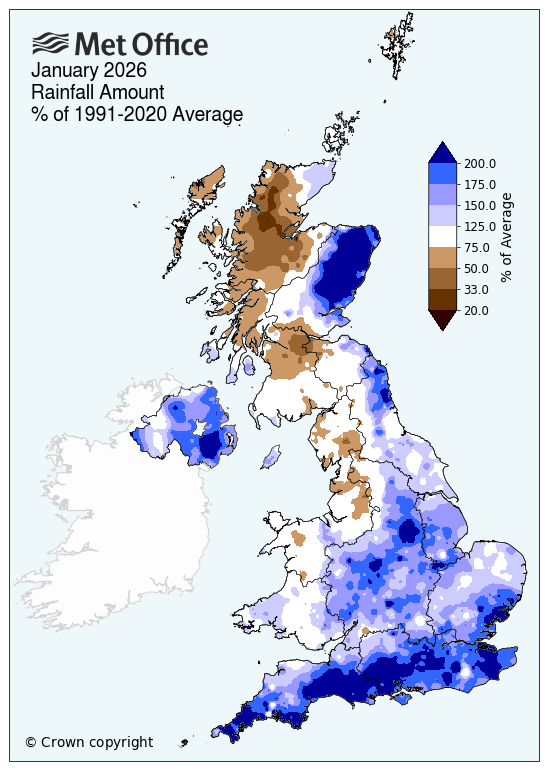
Overall, the UK recorded 17% more rainfall than the long-term meteorological average for January. Northern Ireland recorded 70% more than its January average, making it the second wettest January since the series began in 1836 and the wettest in 149 years, surpassed only by January 1877.
England was also very wet, with the nation recording 50% more rainfall than average. There was a clear north–south divide, with northern England recording 10% more than average, while southern England saw 74% more rainfall than average. This made January the sixth wettest on record for southern England. Scotland was the only nation to record below-average rainfall, with 87% of its average, but with strong regional variation – eastern Scotland saw 48% more rainfall than average, while northern and western Scotland saw below-average rainfall.
At county level, Cornwall and County Down experienced their wettest January on record, with County Londonderry, Dorset, Kincardineshire, Angus, Hampshire, Devon and Surrey all recording their second wettest January since 1836.
A number of UK sites broke their daily rainfall records during the month, with the most notable day for this on 26 January, during Storm Chandra. Katesbridge in County Down recorded 100.8 mm of rain, far surpassing the previous site record of 38.2 mm from 2005. Dunkeswell Aerodrome in Devon reached 52.8 mm, while Hurn in Dorset, Cardinham in Cornwall and Plymouth Mountbatten in Devon all exceeded their previous daily records.
READ: Why has it been so rainy? When will the rain ease?
Below-average temperatures, with snow and storms
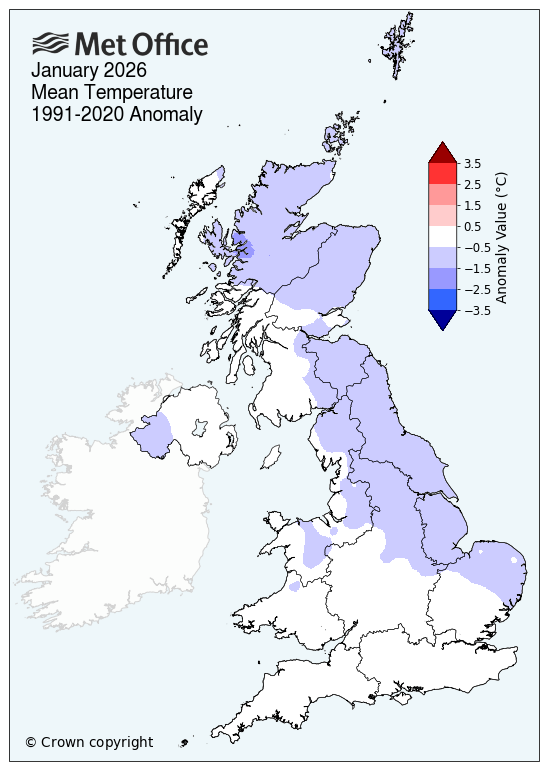
January began with a spell of cold weather as an Arctic airmass moved south, bringing snow, frost, ice and freezing fog to some. Then followed Storm Goretti, named by Météo France, bringing damaging winds to Cornwall and the Isles of Scilly and leading to the first red wind warning of 2026, along with widespread lying snow across Wales, parts of the West Midlands and the South Pennines.
Temperatures rose during the second half of the month, but the UK’s mean temperature for January finished at 0.5°C below average.
Storm Ingrid, named by the Portuguese national weather service, brought more wet and windy weather towards the end of the month before Storm Chandra, named by the Met Office, arrived on 26 January, bringing further heavy rain and strong winds to the southwest of England before pushing northwards and delivering exceptionally heavy rain across Northern Ireland.
Average sunshine hours for the UK
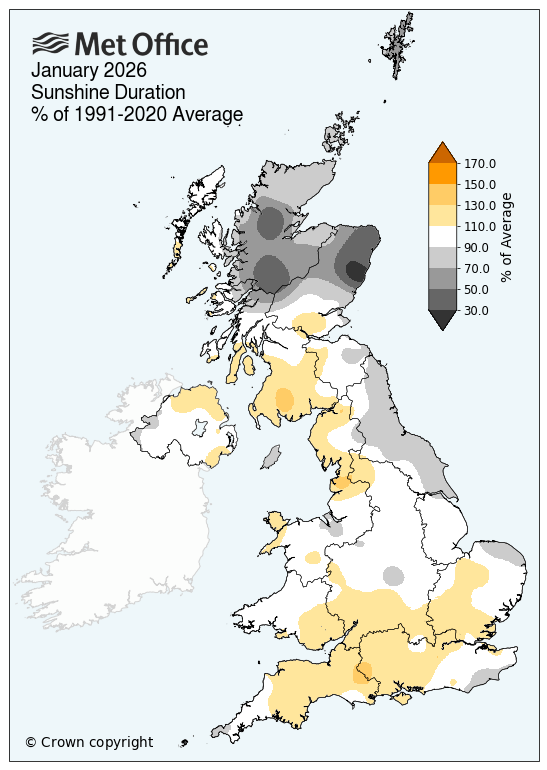
Sunshine levels for the UK were average for January, at 47.7 hours. Scotland was the only UK nation to record below-average sunshine, reaching only around 85% of its typical January total.
How do we know when records are broken?
The answer lies in a Met Office dataset that's been quietly mapping our weather history for around the last two centuries.
|
Provisional Jan 2026 stats |
Mean temp (°C) |
Rainfall (mm/%) |
Sunshine (hours/ %) |
|||
|
Actual |
91/20 anom |
Actual |
91/20 anom |
Actual |
91/20 anom |
|
|
UK |
3.4 | -0.5 | 142.6 | 117 | 47.7 | 100 |
|
England |
4.0 | -0.4 | 124.2 | 150 | 58.3 | 105 |
|
Wales |
4.1 | -0.3 | 175.6 | 113 | 50.2 | 106 |
|
Scotland |
2.2 | -0.7 | 155.2 | 87 | 30.0 | 85 |
|
Northern Ireland |
4.1 | -0.4 | 195.6 | 170 | 43.5 | 102 |