
Global space weather forecasting is getting a step-change in capability as the National Oceanic and Atmospheric Administration’s (NOAA) SOLAR-1 satellite becomes operational.
The satellite, which launched on 24 September 2025, will provide a 24/7 near real-time data stream giving forecasters critical lead time to generate forecasts which help protect satellites, as well as vital infrastructure on Earth.
SOLAR‑1 is positioned at the L1 point, around one million miles from Earth, where its instruments continuously observe the Sun and its outer atmosphere, measuring the solar wind and imaging solar activity as it leaves the Sun.
Last week, the satellite became fully operational for the first time, providing vital detailed information to space weather forecasters around the world.
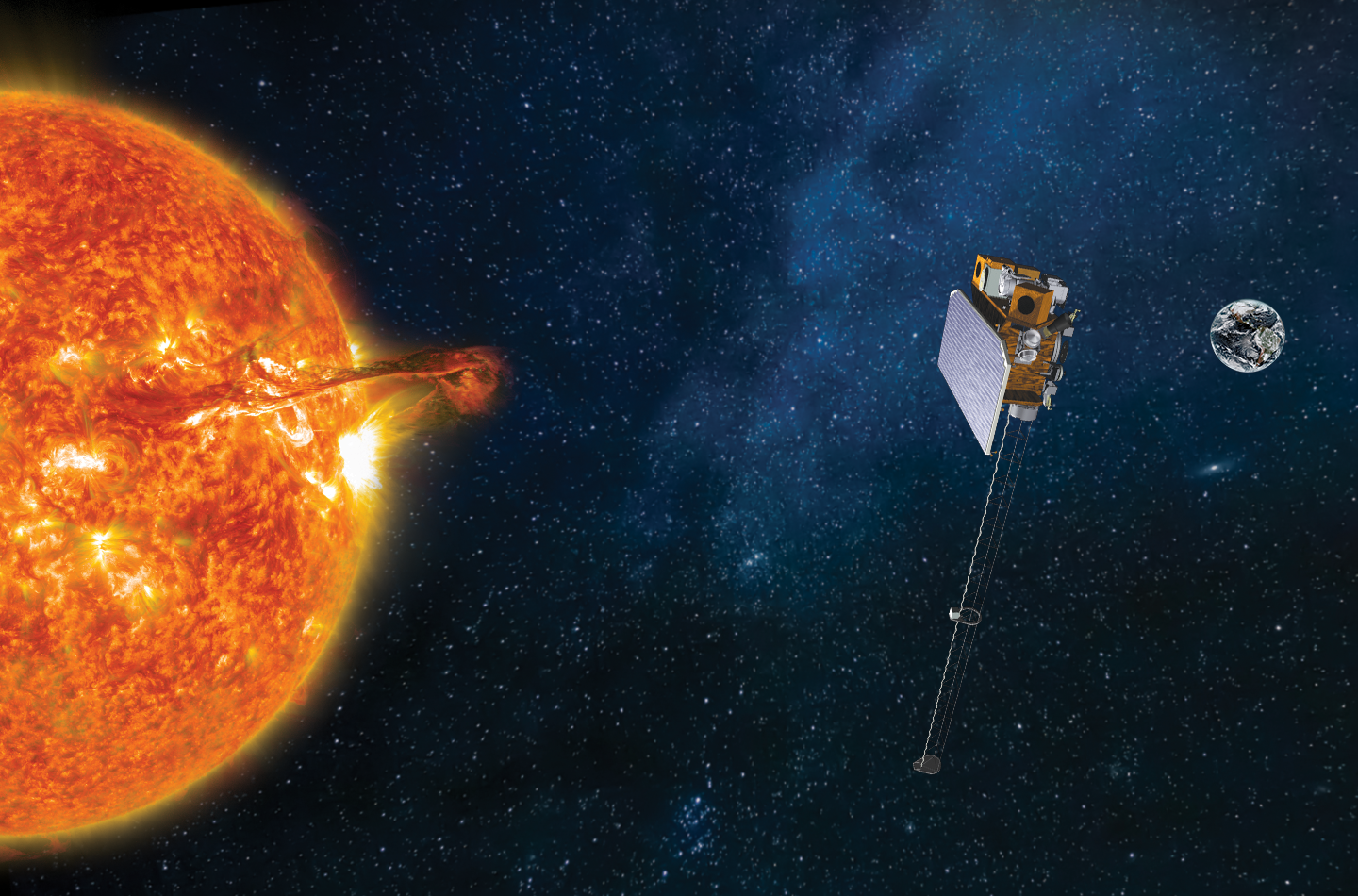
SOLAR-1 will provide crucial data and imagery for space weather centres. (Image: NOAA)
Met Office Space Weather Manager Simon Machin said: “SOLAR-1 provides a real step-change in observations of events emanating from the Sun and will vastly enhance our ability to forecast impactful space weather.
“As one of a handful of 24/7 space weather forecasting centres in the world, we’ll benefit from the improved availability of data from the satellite, with imagery from the coronagraph available around every 30 minutes, while on board data collection measuring solar wind will be available around every five minutes.”
Clinton Wallace, Director of NOAA’s Space Weather Prediction Center, said: “It means more time to act.
“It gives time for power grid operators to prepare, more time for satellite operators to protect assets, more time for aviation and national security partners to understand risk, and more time for human spaceflight teams to protect astronauts and missions.
“SOLAR-1 helps turn observations of the sun into practical decisions that protect lives, infrastructure, the economy and national security.”
https://www.youtube.com/watch/tEVfnl43zuQ?start=0Monitoring the Sun’s activity
SOLAR-1 helps provide continuity of observation data from the L1 position, vital for space weather monitoring and forecasting and building on data from missions that first launched in the 1990s and have operated well beyond their original design lifetimes.
So, what’s the technology on board?
- Coronagraph – captures images of coronal mass ejections as they leave the Sun
- Solar Wind Plasma Sensor – measures the stream of charged particles flowing from the Sun
- Suprathermal Ion Sensor – detects high‑energy particles that often precede major solar storms
- Magnetometer – tracks changes in the magnetic field carried by the solar wind
Now providing imagery and data to space weather prediction centres around the world, including the Met Office Space Weather Operations Centre, the new information will enable enhanced forecasting capability of solar events, better informing models and providing crucial information for expert forecasters.
In addition, the landmark European Space Agency (ESA) Vigil mission, which will place a satellite with a side-on view of the Sun in the L5 position, is planned to launch early in the 2030s and will become Europe’s first operational space weather satellite.
Read more from NOAA on the next phase of the satellite.
Find out more about space weather at the Met Office.