
2025 is already the UK’s sunniest year on record
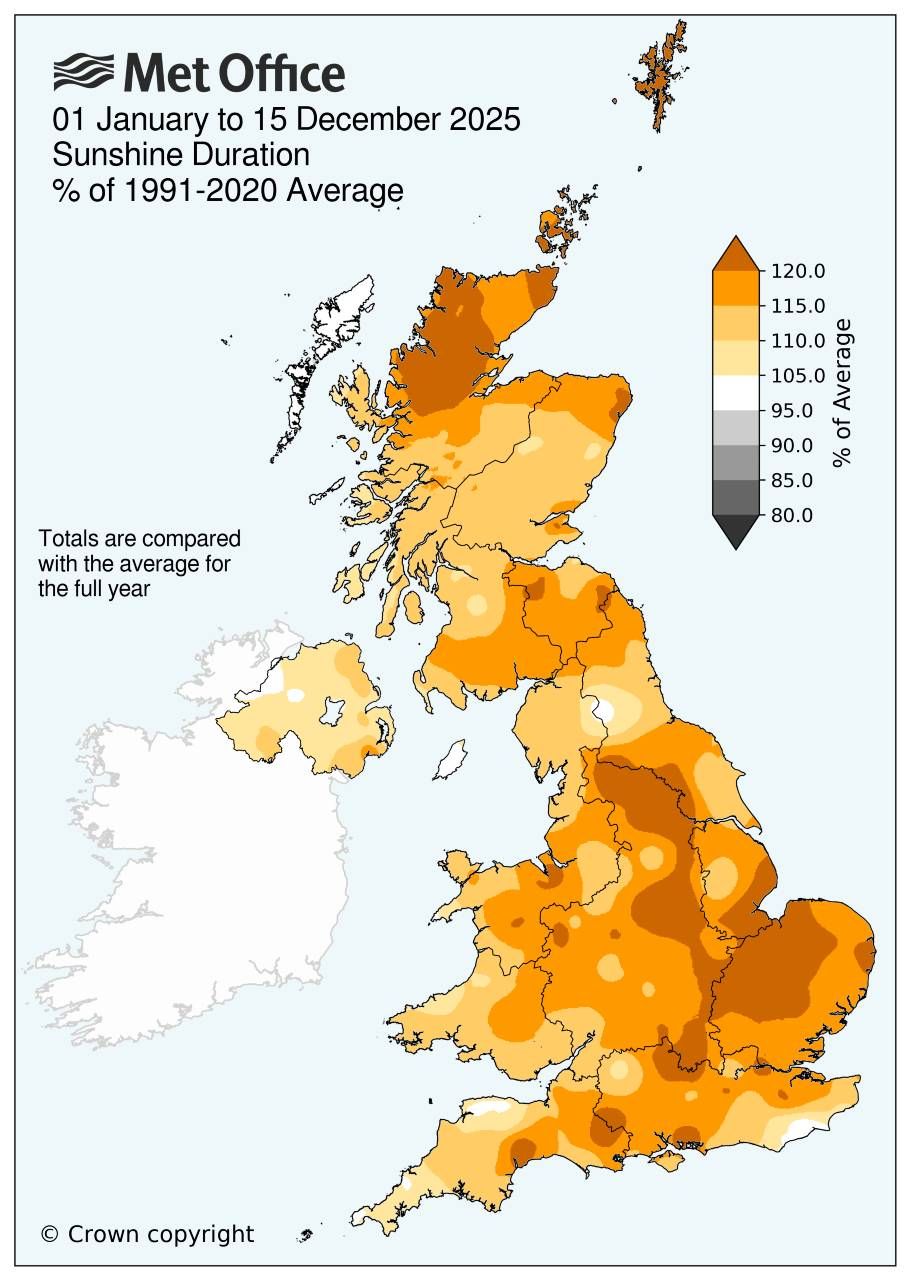
This year has already been the sunniest year on record for the UK, according to provisional Met Office statistics.
The UK recorded 1622 hours of sunshine up until 15 December, beating its previous sunniest year set in 2003, in a series which dates back to 1910.
England too has already had its sunniest year on record, already topping its previous record figure set in 2003.
With a couple of weeks still to go, Scotland has already had its second sunniest year on record, and Wales its sixth. While Northern Ireland has seen above average sunshine so far, it’s not yet within its ten sunniest years on record, though it could yet reach its top ten by the close of the year.
January started the year on a sunny note, before below-average sunshine figures in February helped develop a duller meteorological winter (24/25) than average.
Spring outshone all the seasons with the sunniest spring on record, and the fourth sunniest season on record, beaten by just three summers (1911, 1976 and 1995). Summer was also sunnier than average whilst autumn saw below-average sunshine amounts.
At weather station level, Magilligan, County Londonderry, recorded 301.3 hours of sunshine in May 2025, the highest monthly sunshine total ever recorded in Northern Ireland for any month.
Met Office Senior Scientist Mike Kendon said: “The record-breaking sunshine across the UK this year was driven by the frequent influence of high pressure that reduced cloud cover and brought sunny skies for many.
“Spring was exceptional, and many will remember the long spells of days with largely unbroken sunshine. It began with the third-sunniest March on record, followed by a record-breaking sunniest April and then the second-sunniest May. All three months of the summer also saw above-average sunshine hours and while sunny periods are not unusual at this time of year, the duration and consistency of high-pressure systems made 2025 notably sunnier than average.
“So far this year, only the months of February and October have recorded below-average sunshine hours.”
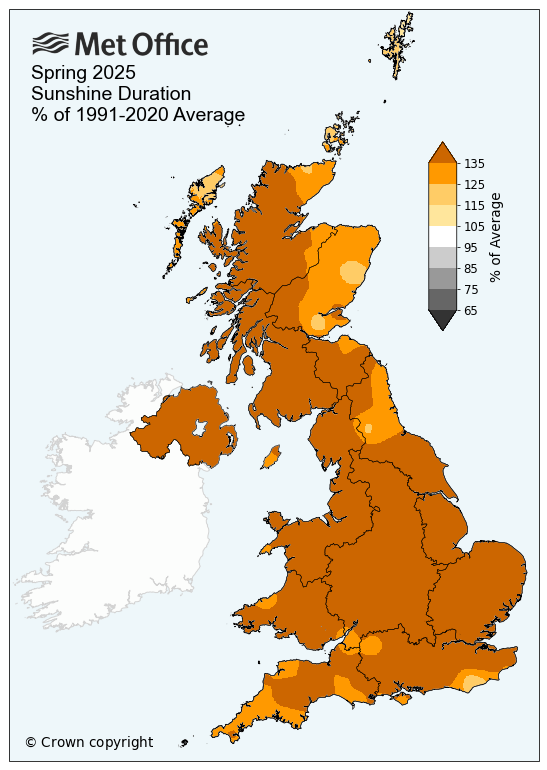
This graph shows most areas receiving over 35% more sunshine than average this spring.
What's the annual sunshine trend?
The latest UK State of the Climate Report highlights how the UK has generally become sunnier since the 1980s. The cause of this trend is uncertain, and it may simply be down to natural variability, though reduced aerosols could be a factor. Climate projections currently show no definitive evidence of a future trend in sunshine amounts due to climate change.
Recent years show this natural variability well, with 2024 the dullest year since 1998, in contrast to 2025 which will now go down as the UK’s sunniest year on record.
Solar energy in the sunshine
According to the National Energy System Operator (NESO), who recently announced a collaboration with the Met Office, the record-breaking sunshine has seen benefits for Great Britain’s energy sector as well. Solar power has provided over 6% of Britain’s annual energy needs so far this year, an almost 50% increase on recent years, though new solar installations also play a role in this figure.
Energy Minister Michael Shanks said: “Solar is one of the cheapest forms of power – getting us off fossil fuels and delivering energy security so we can get bills down for good. The sunniest year on record highlights the huge opportunity we have to make the most of this clean energy source and keep installing more solar panels on schools, hospitals and homes.
“As we move into 2026, we will scale up the solar power we need to shield households from volatile fossil fuel markets and tackle the climate crisis.”
Electricity produced by solar peaked across the sunniest months this year. Between April to August, solar power provided more than 10% of Great Britain’s energy needs. On 8 July, solar even set a new record for total output, providing over 14GW of electricity for the first time. This was enough solar to deliver more than 40% of Britain’s electricity needs at the time.
Craig Dyke, Director of System Operations at NESO, said: “Enabling low carbon technologies like solar to play their part in our energy future is critical to helping us on our journey towards building a cleaner energy future.
“It’s hard to believe how far Britain has come over the past quarter of a century, with renewables now producing around 60% of our electricity – up from just 3% in the year 2000.
“It really shows what’s possible when we back home-grown clean energy as part of our generation mix.”
Weather is one of the most significant variables affecting both energy supply and demand. The Met Office provides a comprehensive range of forecasts and observation data to help energy companies understand how weather will impact their operations.
Phil Hodge, who leads on energy at the Met Office said: “We’re pleased that the Met Office has played a role in helping the energy sector to work efficiently during the sunniest year on record.
“By providing our weather and climate intelligence, we enable energy companies to plan and operate effectively. Our tailored electricity demand data helps NESO to balance supply and demand, reducing the risk of outages or inefficiencies.”
What about temperature and rainfall for 2025?
Provisional Met Office statistics for 2025 so far show this has been another extremely warm year for the UK, with overall rainfall totals below average.
Full provisional Met Office statistics will be released on Friday 2 January 2026, with an interim update expected next week.
How do we know when records are broken?
The answer lies in a Met Office dataset that's been quietly mapping our weather history for around the last two centuries.