Over the past year, the UK’s national weather and climate services have undergone one of the most significant technological shifts in their history.
The first full year of operating a national-scale supercomputing system entirely in the cloud has now been completed, marking a major step forward in how critical forecasting and scientific modelling capabilities are delivered.
This milestone represents far more than an infrastructure upgrade for the Met Office. It signals a fundamental change in how innovation, resilience and scientific progress can be achieved at scale.
The achievement rests on a long-term partnership between the Met Office and Microsoft, combining scientific expertise with cloud engineering to build a platform capable of supporting daily operational forecasts, ongoing research and rapid advances in modelling techniques. It has taken generations of experience in running mission critical systems and paired it with flexible, modern cloud delivery, designed to support the country’s needs today while creating room for long-term growth.
Innovation through systems working together
One of the central ideas behind this transformation is that innovation is rarely the result of a single breakthrough. Real progress happens when infrastructure, data, processes, skills and governance align and mature together.
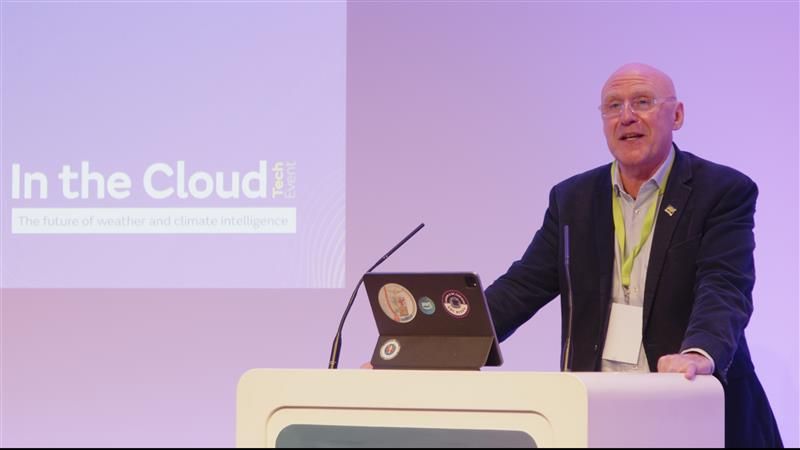
Charlie Ewen, Chief Data and Information Officer at the Met Office, said: “Rather than focusing on any single technology, whether that’s AI, cloud, or whatever the industry happens to be talking about, what matters is the broader combinational innovation that happens when infrastructure, data, skills, processes and governance all evolve together.
“At the Met Office, we work from pioneering research right through to critical operational services, so we’ve spent over a century converting research into practical, useful decision-making intelligence. That experience tells us that real progress comes from aligning whole systems, not chasing isolated breakthroughs. And that is very much the philosophy behind our partnership with Microsoft and the shift to supercomputing in the cloud.”
Innovation is not about hype or dramatic claims. Instead, it is seen as something that compounds over time, layer by layer, to deliver dependable improvements to how the UK understands and prepares for weather and climate impacts. This is particularly important for a national service where accuracy, continuity and public trust are essential.
Supercomputing at scale
The cloud-based supercomputer powering today’s UK forecasts is one of the most capable CPU-based systems in the world, with around 1.8 million processor cores. This massive compute power enables more detailed models, larger ensembles and faster experimentation, giving scientists more room to explore how to improve forecasts.
Erin Chapple, CVP Commercial Solution Areas, Microsoft, said: “The scale of the Met Office’s cloud based supercomputing capability is significant, and it really underpins its ability to deliver the National Forecasting Services.
“The system comprises approximately 1.8 million processor cores capable of performing around 60 quadrillion calculations per second. It is among the most powerful CPU based supercomputers globally and is widely regarded as the most advanced system dedicated specifically to weather forecasting.
“But compute power alone does not deliver better forecasts. It must be harnessed through validated models, high quality observational data and robust workflows. Scale matters, but it matters most when paired with reliability and scientific integrity.”
The shift to cloud supercomputing also reflects a commitment to resilience. Over the past year, availability and reliability matched or even exceeded availability of previous systems. This has been essential during periods of severe weather, when uninterrupted forecasting is critical for emergency responders, government decision making and public safety.
Why year one focused on stability
Introducing this level of technological change requires careful management. The first year of live cloud operation prioritised stability above all else. Rather than pushing for immediate leaps in modelling complexity, the aim was to establish a predictable, dependable foundation.
By building a strong baseline, the system is now well positioned to support the next wave of improvements, whether that is enhanced modelling physics, new ensemble configurations or the verified use of artificial intelligence in specific parts of the forecasting chain. One of the key features of the cloud-based platform is the combination of stability for long-running science activity but also the flexibility to innovate and accommodate new breakthroughs, quickly.
A new delivery model for long-term progress
A key element of this transformation is the delivery model itself. Rather than a traditional ‘build and handover’ procurement, the cloud supercomputing platform is run as a long-term, managed service partnership. Engineering teams across organisations work side by side, continually refining the platform and ensuring that scientific advances can be integrated as soon as there is robust evidence to support them.
This structure sustains institutional knowledge, accelerates iteration and creates shared accountability for outcomes.
Multidisciplinary teams work more closely than ever, reducing bottlenecks and shortening the path between research breakthroughs and operational use. At the same time, any new AI or machine learning techniques are subject to rigorous verification before adoption, ensuring that trust and scientific integrity remain central.
The Met Office as a facilitator
Within this complex ecosystem, the Met Office plays a unique role as a facilitator. This means bringing together technology, science, data, AI and trusted workflows to deliver insights that matter for the UK. The shift towards modular, cloud-based services and open data platforms reduces the time teams spend maintaining infrastructure, allowing more capacity for innovation and service development.
Credibility and public trust remain central pillars of the mission. Whenever new methods or tools are evaluated whether computational, scientific or data driven, the questions are the same: Is it resilient? Is it transparent? Does it improve outcomes? This careful stewardship ensures the UK’s weather and climate services maintain their reputation for rigor and reliability.
What comes next?
Looking ahead, the focus is on continuing scientific upgrades in a measured, evidence-based way.
Future enhancements will build on the solid foundation established during the first year in the cloud. The coming years will likely bring improved model resolution, better representation of high impact weather, faster experimentation cycles and more seamless integration between research and daily operations. As the climate continues to change and weather becomes more volatile, the need for reliable, scalable and innovative forecasting capability will only grow.
You can find the latest forecast on our website, on YouTube, by following us on X and Facebook, as well as on our mobile app which is available for iPhone from the App store and for Android from the Google Play store.