As climate risks intensify and the need for timely, actionable intelligence grows, the challenge facing weather and climate science is no longer just producing more data but ensuring that data leads to better decisions.
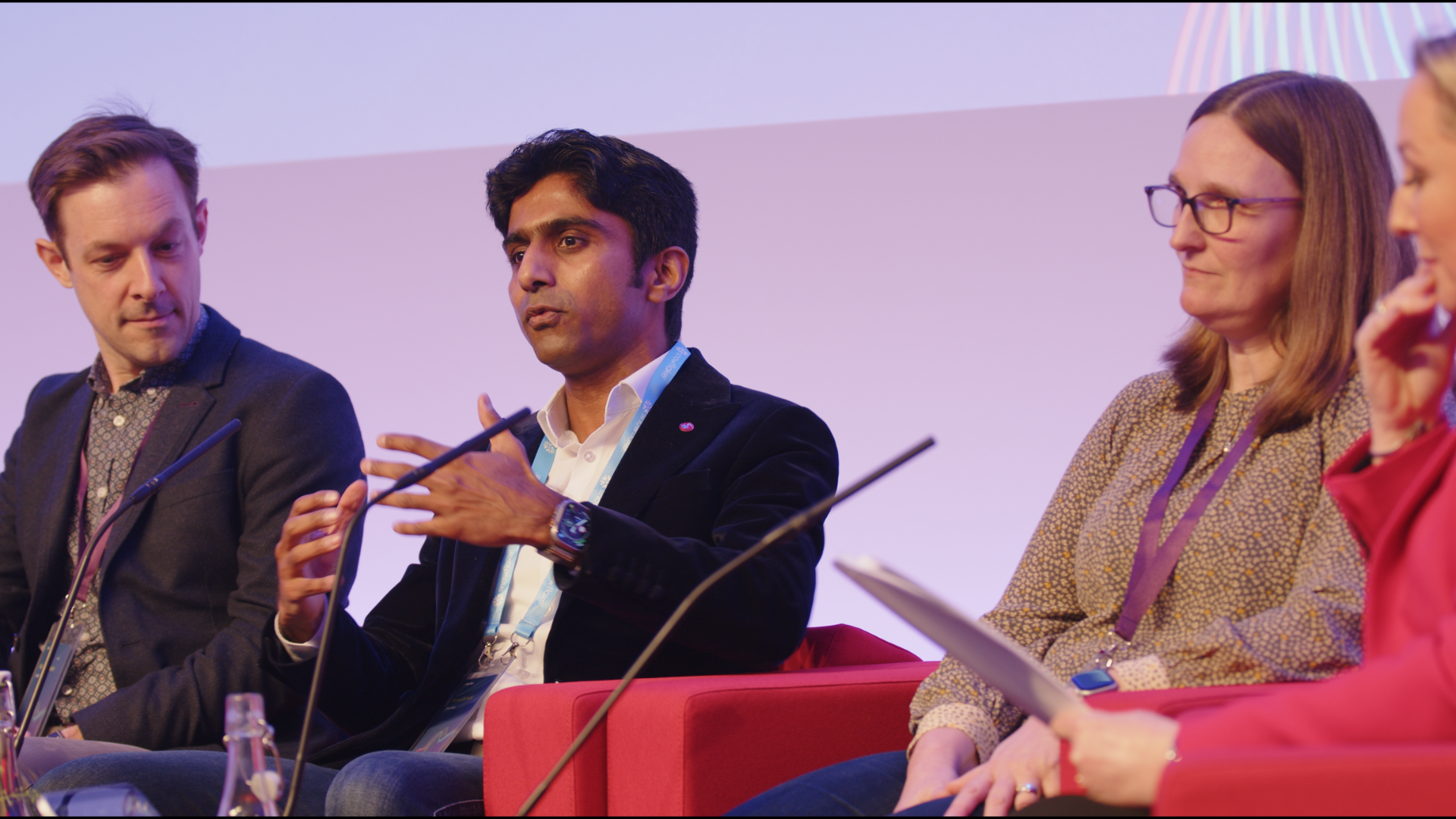
That challenge was at the heart of the panel session “From Data to Decisions: AI Factories for a Climate Ready World”, held during the Met Office in the Cloud event in London earlier this month.
Bringing together experts from science, technology and industry, the discussion explored how advances in supercomputing, cloud infrastructure and artificial intelligence are transforming weather and climate intelligence.
Supercomputing as the engine, supported by an ecosystem
Supercomputers remain fundamental to weather and climate prediction, powering the complex numerical models that underpin forecasts. Historically, growing computational capacity and capability has fuelled and enabled scientific advance and better models.
Richard Lawrence, Principal Fellow for Technology, at Met Office, said: “The supercomputer for us has always been a tool, it's a phenomenal tool. It's like a Formula 1 car that is great at speeding up the calculations and everything we need to do to produce forecasts for our customers and users. And one of the great things that supercomputers have historically done is they've increased their performance year on year on year for the same kind of cost.”
However, the panel highlighted that the pace of performance improvement within a budget seen in the past has slowed. As a result, sustaining innovation now depends less on anticipating growing scale alone and more on how traditional supercomputers are used alongside complementary technologies.
Richard continued: “Supercomputers have been a real engine in driving innovation and allowing us to do more and more science within our organisation.
“That speed up and performance improvement characteristic has changed dramatically over the past two years and so we're having to rely upon other ways to make sure we keep that pace of scientific innovation going, and that's from leaning into our cloud partners and using all the other services they have in and around the supercomputer in the cloud.”
AI unlocking new applications
Artificial intelligence is playing a growing role across weather and climate services. While comparisons with traditional numerical weather prediction continue, the panel emphasised that AI’s real value often lies in enabling entirely new applications that blend traditional and emerging technologies
Dr Niall Robinson, Product Lead for Weather and Climate, at NVIDIA, said: “What I think is really interesting is all the new applications that have opened up through AI. So, for instance, one of the ways we see AI being used quite often is by the risk industry. That’s one application we see a lot.
“Similarly with downscaling to make bespoke predications about certain operations. So, if you run a particular regional solar power farm, for instance, you’re now enabled to start targeting bespoke forecasts for your operations that are tailored to your needs/ These things just wouldn't be possible without AI.”
Fawad Qureshi, Field CTO at Snowflake said: “The role of a public agency to create net social value. This can be achieved through creating a network effect of data. This is what the Met Office has done by delivering £56 billion of economic value back to the society and for every £1 spent from the taxpayer budget £19 are injected back to the society. This is achieved by facilitating the free flow of data and information across the entire society.”
Modern hardware and scientific challenges
Advances in computing architectures are also reshaping forecasting. Graphics Processing Units (GPUs) now dominate the world’s latest supercomputers, enabling exascale computing optimised for AI workloads
Professor Michèle Weiland, from EPCC, the national supercomputing centre at The University of Edinburgh, said: “In terms of architectures, GPUs are what drive the majority of the supercomputers in the world today. And their performance is phenomenal. Their performance in terms of their computational performance versus their power usage is phenomenal. It’s how we’ve reached exascale computing. Unfortunately, scientific, numerical code hasn't fully caught up yet and now the rapid hardware development is driven by AI, not by scientific computing.”
Whilst AI approaches are transforming the computing landscape, including weather and climate prediction, the panel explained that is not a traditional physics on CPU versus AI on GPU, problem. AI will not replace Physics and GPU’s won’t entirely replace CPUs – both are needed working together. Intensive research is underway at the Met Office and elsewhere to understand how to deliver this ‘best blend’ of methods and the cloud supercomputing platform is ideally suited to this research and development.
AI, energy use and environmental responsibility
The environmental impact of AI was another key area of discussion. Training and developing large AI models can be very energy intensive, raising questions about sustainability. At the same time, AI has the potential to improve efficiency and support better climate related decisions.
Dr Niall Robinson, Product Lead for Weather and Climate, at NVIDIA, said: “If we look at the opportunity afforded by running AI models on GPU. Certainly, in terms of the amount of energy needed to create a weather prediction. AI, as far as I can see, is nothing but positive.”
Professor Michèle Weiland, from EPCC at The University of Edinburgh, said: “I would push back on that. Because, yes, you can run a weather forecast on your workstation. But the work that goes into getting to the point where you can do the inference, the pre-training, the training and so on is very energy intensive. I think it’s energy well spent if you do it for the right reasons and if you do it well. The concern is more about ensuring that all of the resources we put in are actually used properly. We have a responsibility to use compute resources as efficiently as we possibly can.”
Fawad Qureshi, Field CTO at Snowflake said: “As per the World Economic Forum, the carbon emissions from AI are doubling every 100 days. AI may be energy intensive, but the discussion needs context. Yes, training models consume significant power, and that should not be ignored. But if AI is applied to solve meaningful problems, improving weather prediction, reducing energy loss, optimising infrastructure, or addressing climate risk, the net economic and societal benefit far outweighs its carbon cost.
“The real issue is not that AI uses energy, but whether we use it responsibly and efficiently. Poorly utilised systems, idle infrastructure, and wasteful design create far more impact than purposeful AI ever will. The focus should be on maximising outcomes per unit of energy, not avoiding the technology altogether.”
The panel agreed that sustainability is a key factor and ensuring that supercomputing resources are deployed responsibly and thoughtfully, should be a key area of focus.
Trust and consistency across the data value chain
Weather and climate predictions are saying something about a future that has not yet taken place. As the data that represents those forecasts is increasingly shared, repackaged and visualised across digital platforms, ensuring that the probabilities and likelihoods associated with future weather are communicated become an important part of improving accuracy and consistency. Those nuances of likelihoods can be very sensitive to technology changes.
As with any good science, the Met Office is cautious about changing methods driving changed results as this can have disproportionate impacts, particularly when forecasts are used to inform public behaviour, business decisions or critical operations.
The session concluded with a clear message: progress depends on how technologies are combined, not on any single solution. Supercomputers, cloud platforms, AI methods and strong governance all play a role in turning data into decisions.
As climate challenges become more complex and more localised, delivering timely, trusted and actionable insights will be increasingly important.
The speakers were talking at Met Office in the Cloud; a technology event bringing together leaders from across industry and government.