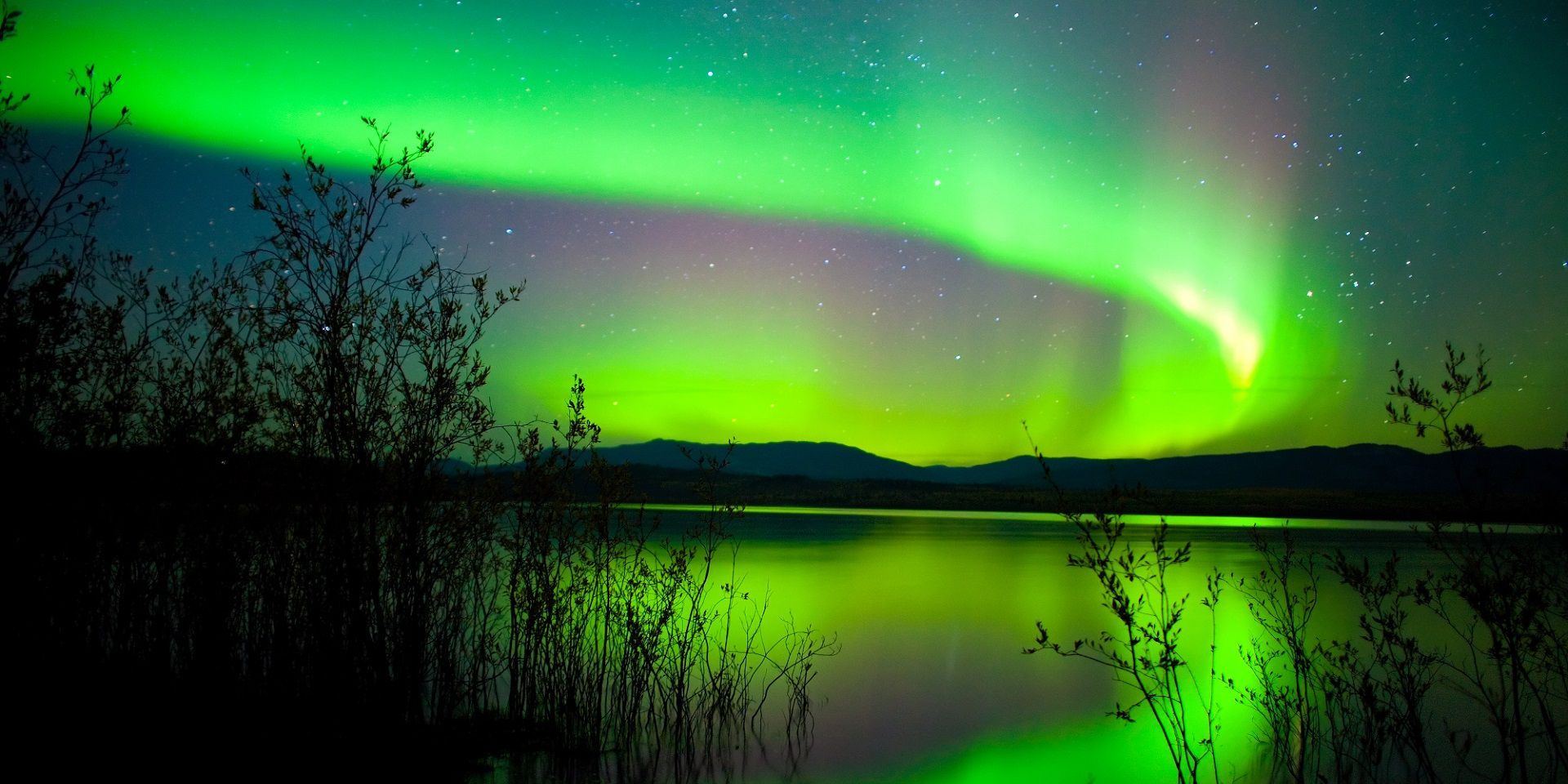
Fast solar winds, possibly accompanied by a glancing coronal mass ejection, could result in aurora sightings across much of Scotland tonight.
There may also be a slight chance of sightings from Northern Ireland and northern England. However, viewing conditions will be mixed. Showers should gradually fade overnight, but mostly cloudy skies will likely restrict visibility. The best opportunities are likely to occur beneath temporary breaks in the cloud, particularly from darker locations with a clear view towards the northern horizon.
Aurora sightings are driven by activity on the Sun, but how does the wider solar cycle influence space weather?
As the Sun moves away from the peak of its most recent solar cycle, it is natural to assume that space weather activity will also begin to fade away. After all, fewer sunspots usually mean a quieter Sun.
However, while solar minimum itself is associated with lower levels of solar activity overall, it does not mean space weather stops. In fact, significant space weather events can occur during the declining phase of the solar cycle and even close to solar minimum itself.
Understanding the solar cycle
The Sun undergoes an approximately 11-year cycle of activity, moving from periods of low activity, known as solar minimum, to periods of high activity, known as solar maximum. One of the primary ways scientists monitor this cycle is by counting the number of sunspots visible on the Sun's surface. When sunspot numbers are high, the Sun is generally more active and capable of producing more solar flares and coronal mass ejections (CMEs), as these typically originate from sunspot regions.
Recent observations suggest that solar maximum occurred during 2024 and 2025, with sunspot activity now beginning to trend downwards as the cycle enters its declining phase.
While a decreasing sunspot count suggests that the frequency of Earth-directed space weather is reducing, this does not dictate the magnitude of individual space weather events, and the reality is that impactful events can still occur at any point during the cycle.

A graph displaying solar cycle sunspot number progression. Credit: NOAA
READ MORE: Deeper Dive: The school-taught physics that helps us understand space weather
Solar minimum and solar maximum
While some will assume that a transition towards solar minimum stops the occurrences of space weather, that’s simply not the case. While the overall number of sunspots gradually declines as we head towards solar minimum, impactful events, including powerful solar flares and large CMEs, can still occur during this phase
These events can trigger geomagnetic storms, disrupt radio communications and navigation systems, and create auroral displays visible far from the polar regions.
Coronal holes become more important
Another reason space weather continues during solar minimum is the increased prevalence of coronal holes driving activity.
Coronal holes are regions of the Sun's atmosphere where magnetic field lines are open, allowing high-speed streams of solar wind to escape into space. During solar minimum these features can become larger, more persistent and longer-lived than during solar maximum.
When these high-speed solar wind streams interact with Earth's magnetic field they can trigger geomagnetic storms. While these storms are less intense from those associated with major CMEs, they can still produce auroras, interfere with satellites and affect some technological systems.
For this reason, it is entirely possible to experience space weather even when sunspot numbers are relatively low.
READ MORE: How the Met Office forecasts space weather and why it matters
Strong events can occur after solar maximum
Another important point is that the most impactful space weather events do not always occur exactly at solar maximum.
In fact, historical observations show that many of the most significant events have taken place during the declining phase of the solar cycle, after the peak in sunspot activity has already passed. As a result, a downward trend in sunspot numbers should not be viewed as a signal that severe space weather risks have disappeared.
The current cycle has already produced several notable events, including geomagnetic storms that allowed auroral displays to be seen across unusually southerly parts of the UK. Such events demonstrate both the continued importance of monitoring the Sun and the growing relevance of space weather forecasting in a technology-dependent world.
Why space weather still matters
Space weather is recognised as a significant potential threat to modern infrastructure. Satellites, radio communications, power networks and Global Navigation Satellite Systems (GNSS), including GPS, can all be affected by solar activity. Severe solar storms can cause radio blackouts, navigation errors and, in extreme circumstances, impacts to power grids.
As society becomes increasingly reliant on these technologies, accurate space weather forecasting remains essential regardless of where the Sun sits within its activity cycle. Continuous monitoring helps infrastructure operators, government agencies and industries prepare for potentially disruptive events.
https://www.youtube.com/watch/tICC8ltH8G0?start=0Keep up to date with weather warnings, and you can find the latest forecast on our website, on YouTube, by following us on X and Facebook, as well as on our mobile app which is available for iPhone from the App store and for Android from the Google Play store.