The transition to a clean, resilient and affordable energy system is in everyone’s interest, and the last few months have enabled me to use my expertise in weather and climate extremes and impacts, alongside knowledge of the energy sector, to directly address this challenge.
Since a Memorandum of Understanding was signed between the Met Office and the National Energy System Operator (NESO) in November, I have been embedded in NESO to work closely with senior colleagues to support the development of the strategic relationship, develop a five-year plan, and support near term actions alongside the Met Office partnership manager and Industry Science and Consultancy colleagues.
Dependable today, resilient tomorrow
The security of Great Britain’s energy system is NESO’s number one priority, balancing supply and demand second by second, 365 days a year. With the reliability of our system at 99.999% in 2024/25, Britain has one of the most dependable electricity systems in the world, but complacency is not an option in a changing climate.
As the power system decarbonises, and more of our electricity comes from renewable sources, weather will be the fuel of our future energy system. And that means that being able to accurately predict the weather is more important than ever. At the same time, our weather is changing. Climate change means that historical weather patterns are becoming a less reliable guide to the future. In addition, increasing weather extremes such as heat and combinations of wet and windy weather are a major risk for the energy network.
The partnership between the Met Office and NESO brings together the energy system operator, charged with keeping the system secure and reliable, and the UK’s national meteorological service and world-leading climate research organisation - sharing expertise and using weather and climate intelligence to improve energy system resilience to a changing climate.
Keeping the lights on…
NESO and the Met Office are taking action to ensure that there is continued confidence in weather predictions and therefore the amount of power renewables will produce, which is essential for maintaining system security. Fundamental to this will be improvements to the underlying numerical weather prediction, with the recent upgrade to the Met Office Unified Model expected to lead to improved solar and wind forecasts.
Data are also a key component of this - data volumes are exploding and provide ever more detail to better understand the world. A digitisation programme means that NESO is now ingesting vastly more weather data - ~35 gigabytes per day from the Met Office Weather DataHub; ~100 times more than previously - but how this is used is critical. This data gives NESO access to weather forecasts with more spatial detail (i.e. gridded) and also high-resolution ensembles, enabling them to determine the impact of different weather scenarios on future generation and demand.
At the Met Office we provide estimates of forecast certainty through the use of ensembles. Instead of running a single forecast, our computer model runs a number of times from slightly different starting conditions, recognising that the atmosphere is a chaotic system and that initial uncertainties can make a big difference several days ahead.
Whilst data can help with making good decisions to keep energy supplies safe, it is important to improve how data is used to ensure that the insights are not lost in the noise. Risk-based energy scenarios, for example, incorporate weather ensembles.
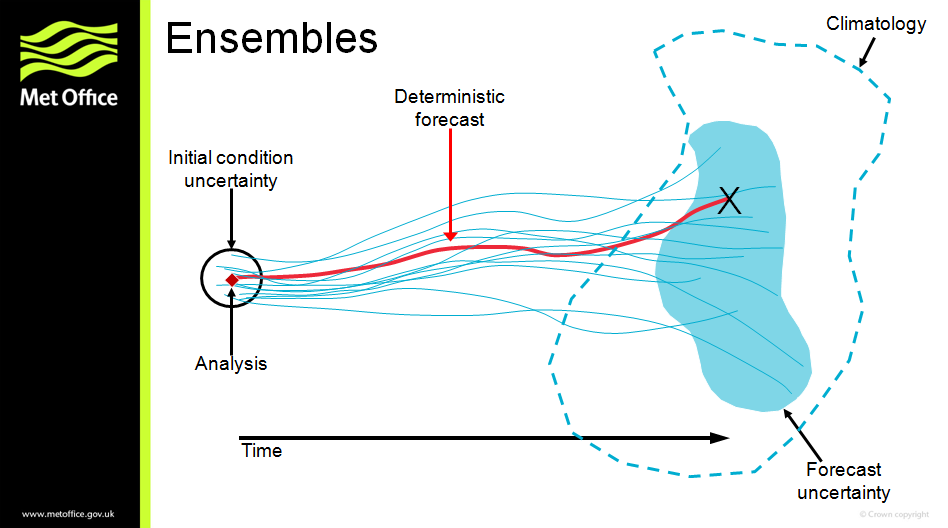
The ensemble helps us understand the chances of specific tricky weather - for NESO a challenging outcome might be low winds in the North Sea reducing the wind generation, or a build-up of cloud in the South reducing solar generation. The ensemble helps us understand the chance of either of these events. If used well the ensemble can provide more information than either of those risks alone - it can help us understand the risk of them occurring together. And this is exactly what NESO has done, enabling them to better understand the chance of tricky combinations or scenarios of weather, and how non-linearities will translate into relevant renewable generation and demand on our system. A much more accurate view of risk can be generated, and NESO have noted recent accuracy improvement. NESO’s day ahead wind forecasts have improved since these changes.
… and the costs low
Accurate forecasting is also important for keeping costs low. Knowing how much wind or sun there is likely to be on a given day allows NESO to plan how many other generators might be needed to ensure there is enough power to meet demand. Overestimating the amount of power available from wind turbines and solar panels may mean instructing more generation from carbon-intensive gas plants at short notice, leading to higher costs or a risk that there is not enough power for everyone who wants it. Underestimate (leading to more generation than demand), and instructions to decrease power at short notice also carry cost. These balancing costs can ultimately affect consumer bills.
Continuous improvement
It is relatively early days in the formal partnership between NESO and the Met Office, with plenty of opportunities to reap further benefits from our shared expertise. The digitisation programme means than continuous improvement is achievable as the system is scalable and can be updated to take account of the latest changes to the energy system, and to bring in new weather and climate science more readily.
Just last month, the Met Office launched a major upgrade to our forecasting system. Tangible improvements will make forecasts easier to interpret, and, for example, winter temperature forecasting advancements will mean more accurate energy demand prediction and cost-effective resource planning for the energy industry.
AI is also likely to bring about further improvements. Met Office and NESO are starting to explore novel use of observing technologies, such as satellites and sky-facing cameras, in conjunction with the latest AI methods and traditional physics-based weather forecasts to improve the quality of solar power forecasts. This could provide a significant advantage over the use of physics-based forecasting alone - watch this space for more on that in the future.
A shared endeavour
By working more closely together, the Met Office and NESO can improve the accuracy of weather modelling for the energy sector, ensuring a more secure and efficient system. The energy industry must be prepared for future disruption in a changing climate, and this partnership will ensure it is equipped to deal with an even wider range of weather-related impacts.