
For more than a century, the Met Office's National Meteorological Archive has held a treasure trove of historical weather data, some of it dating back to 1837. Now, thanks to a major project, tens of millions of these records have been made available in the countries where they were originally recorded.
Part of a wider cataloguing initiative, the Climate Data Rescue project has made accessible 47 shelves of historical meteorological archive material, scanning 1,143 volumes and more than 302,000 source images. The result: at least 54 million additional meteorological observations, covering 95 countries, are now freely available online, opening up new possibilities for climate research and resilience planning around the globe.
An extraordinary treasure trove
The National Meteorological Archive has acted as the custodian of UK meteorological records since 1914. It also holds extensive collections gathered from across the former British Empire and colonial period and largely spanning from around 1848 - 1947. These volumes were well-known within the archive and have always been available for research. But as the archive is so vast, there was limited page-by-page catalogued detail on their exact contents and significance.
Among the most remarkable discoveries was the earliest record in the collection: data from Port Arthur, Tasmania, dating back to 1837, believed to have been collected by Sir John Franklin and later passed via Sir John Herschel, possibly through the Royal Society. The team also uncovered a previously unknown logbook from HMS Terror, recorded in Tasmania in 1842 to 1843 while the ship was part of the Ross Antarctic Expedition, and learned about a dedicated international network of weather stations.
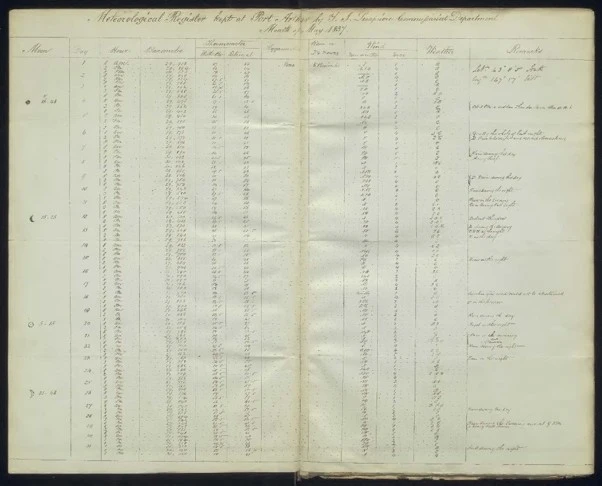
The oldest record in the collection from Port Arthur, Tasmania 1837. Collected by Sir John Franklin
Some countries have seen particularly significant increases in available historical data, including South Africa (1853 to 1928), Nigeria (1887 to 1956), Ghana (1893 to 1948), Yemen (1891 to 1967), Somalia (1903 to 1960) and several Caribbean nations including Barbados, Trinidad and Tobago, and Belize.
Catherine Ross, who led the project at the Met Office's National Meteorological Archive, said:
"When we started this project, we knew we would be making valuable data available, but some of the new data we found took us by surprise. Discovering records like the HMS Terror logbook or realising we held an entire international network of weather stations that was previously unknown, it's been an incredible journey through this part of the archive.
This isn't just about scanning historical documents. It's about improving access to valuable climate observations preserved within the National Meteorological Archive and helping researchers, meteorological services and decision-makers around the world make use of them.
A partnership with global reach
The project was funded through the then Department for Science, Innovation and Technology (DSIT), now BIST (Department for Business, Innovation, Science and Trade), and the Tactical Fund under the International Science Partnerships Fund (ISPF). It was delivered through close collaboration between the Met Office and the Science and Technology Network (STN), based at the British High Commission in South Africa.
Both the Met Office and STN recognised the scientific and diplomatic value of unlocking historical climate records held in UK archives. They worked together closely to secure the support and funding needed to turn that opportunity into reality.
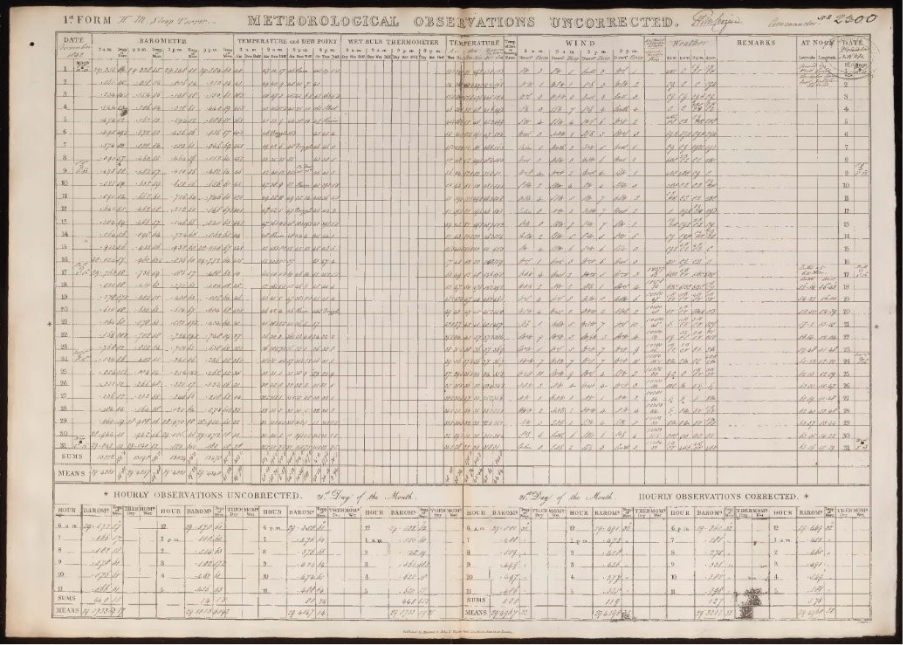
A log from HMS Terror at Tasmania during the Ross Antarctic Expedition from 1842 to 1843
An STN spokesperson said: "This project demonstrates the value of the partnership between the Met Office and the Science and Technology Network. By combining world-leading climate expertise with STN's international reach and in-country relationships, we've helped unlock historical climate information that can now support researchers, meteorological services and decision-makers across 95 countries. The Science and Technology Network is proud to have supported a partnership with the Met Office that is helping make this information easier to access and use.”
Catherine Ross from the Met Office added: “None of this would have happened without STN. Their support throughout has been vital in helping us turn an idea into a tangible outcome with real international significance Our technical archive expertise, matched with the international reach, local knowledge and diplomatic convening power of STN's network, means we’ve delivered something neither of us could have achieved as easily alone”
Enabling delivery, and now driving uptake
STN's role hasn't stopped at helping to get the project off the ground. As the archive collections move from digitisation into active use, STN continues to play a central part in connecting this newly available data with the climate leads, national meteorological services and researchers who stand to benefit most, particularly across Africa. Here its in-country presence and relationships are helping build awareness and drive use of the data in ways that would be difficult to achieve from the UK alone.
Why it matters
Many countries face significant challenges accessing long-term climate records, whether due to historical archiving practices, institutional change, conflict or resource constraints. Restoring access to this data helps fill critical gaps.
The project supports the World Meteorological Organization's Unified Data Policy, which promotes greater international access to and exchange of environmental observations, benefiting climate research, international scientific collaboration and resilience planning.
Notably, the work has already helped other countries fill gaps in their own records. Italy, for example, has been working with Libya on data rescue efforts and had a gap in records from the early to mid-1940s. The newly digitised Met Office data helps bridge that gap, improving the continuity of Libya's climate record.
What's next?
The project also produced a guide exploring how artificial intelligence and machine learning could support future data rescue efforts, offering practical guidance for archive prioritisation, image processing and data extraction that could benefit similar projects worldwide.
The Met Office presented the project's methodology at the European Geosciences Union (EGU) General Assembly earlier this year, where it generated significant interest, with researchers and institutions in Africa, Malaysia, Brazil, Canada and Australia already exploring the newly available data.
Looking ahead, the Met Office and STN are exploring how this successful partnership model might support further collaboration, including future data rescue activities and emerging work on AI for climate applications.
All the digitised records are freely and publicly available now in the International Observations section of the National Meteorological Archive's digital platform, enabling countries and researchers to begin making use of this newly unlocked climate history.