
With solar maximum all-but-confirmed to have taken place in 2024 and 2025, the activity on the surface of the Sun appears to be in a declining phase, as part of its 11-year cycle from one solar maximum to the next.
But while the number of sunspots on the surface of the Sun is showing a downward trend, this phase can be a period which can often bring strong events, as evidenced by last week’s aurora visibility as far south as northern Italy.
A slow return to solar minimum
Activity on the surface of the Sun is responsible for space weather, which is what experts at the Met Office Space Weather Operations Centre (MOSWOC) spend their time monitoring and forecasting to help critical sectors mitigate against impacts from severe space weather events.
The solar cycle, which is the Sun’s transition from one solar maximum to the next, is chiefly measured through the number of visible sunspots on the surface of the Sun.
As the National Oceanographic and Atmospheric Administration (NOAA) graph below shows, sunspot activity appears to be on a downward trend, as expected.
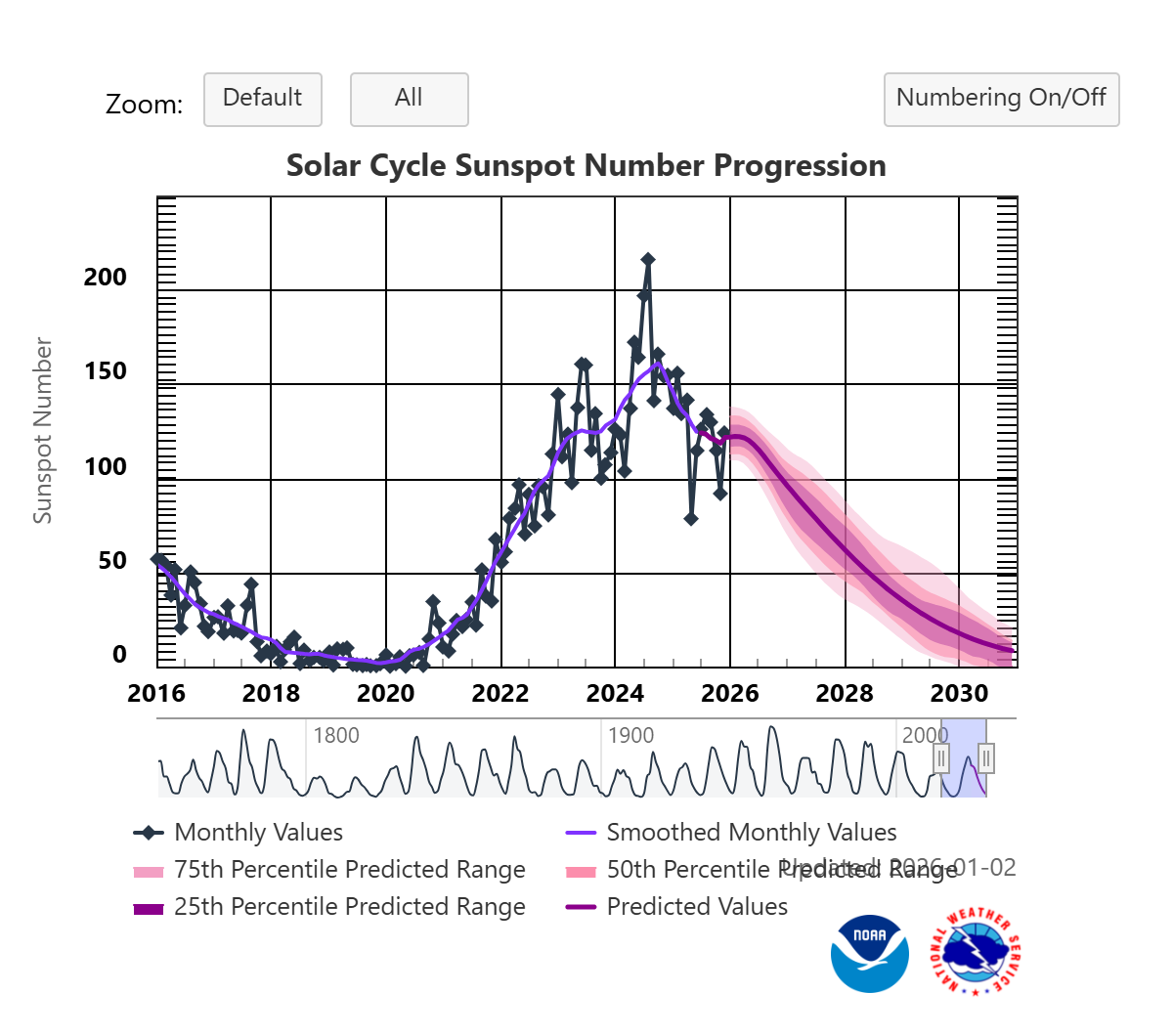
The graph, from NOAA, shows the number of sunspots during the most recent solar cycle.
However, this doesn’t necessarily spell the end of impactful space weather or aurora sightings in the coming months.
Met Office Space Weather Manager Krista Hammond explained: “The Sun’s overall activity may be in a declining phase, but our vigilance for severe space weather certainly isn’t.
“While the total number of sunspots appears to be on the wane, as expected, it’s important to note that we have observed in the past the strongest and most significant space weather events after solar maximum has occurred. This means that there remains an ongoing chance of further significant space weather events, which could bring the potential for aurora sightings for some, with a larger window for this visibility during the darker winter months.”
The solar cycle so far
The Sun’s activity during this solar cycle has been higher than the previous solar cycle, with solar maximum itself more marked, making this the largest solar maximum since the inception of MOSWOC in 2014 but not notable by historical standards.
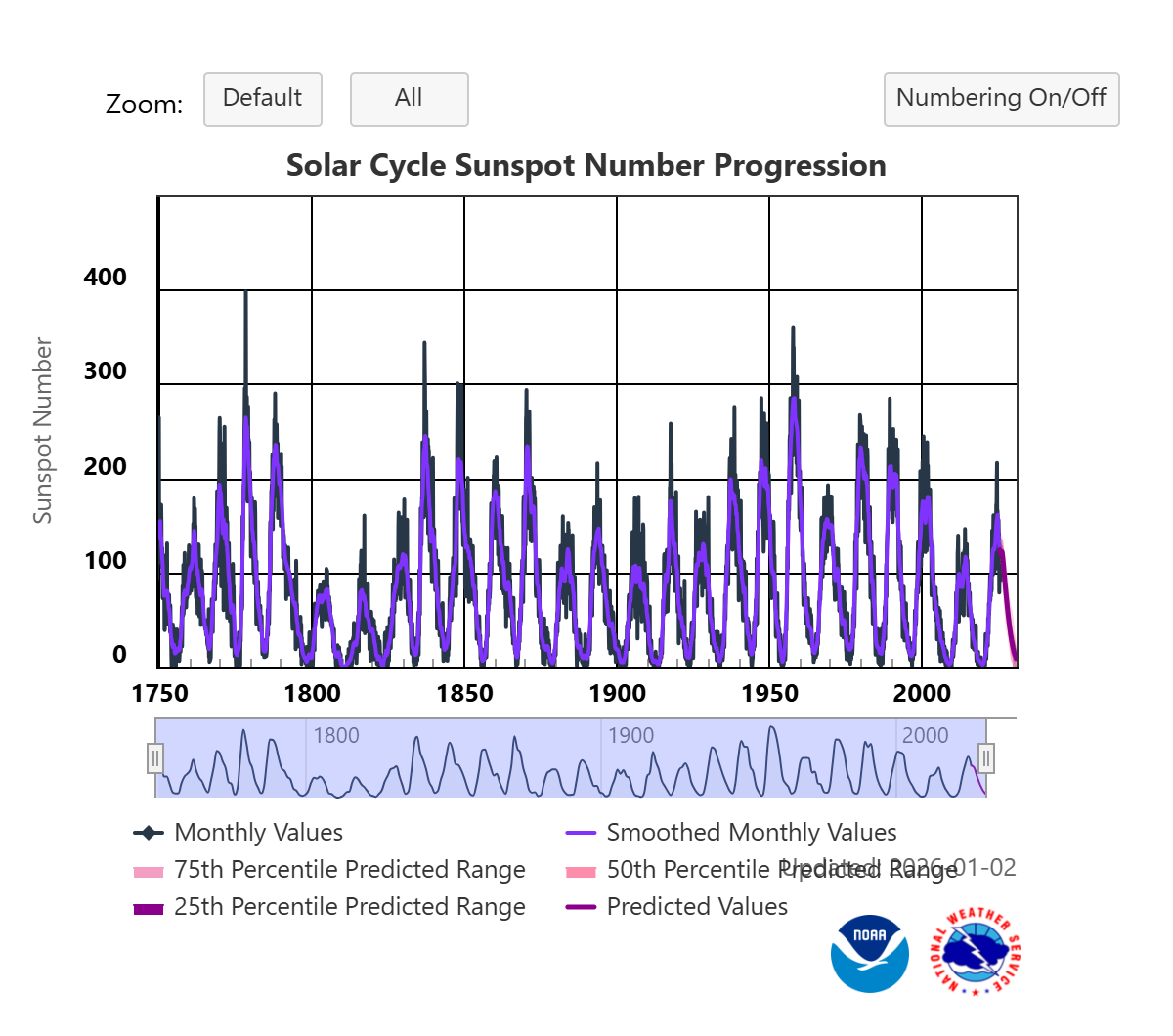
The graph, from NOAA, shows amount of sunspots back to 1749.
“Historically, it has been a relatively typical solar cycle so far, with some notable one-off events, like in May 2024, which brought auroras to southern parts of the UK,” said Krista.
“This event was useful from a preparedness point of view, allowing us to stress-test our communications and alerts to key industries and ensure our expertise can be used effectively across the UK.”
A recent Value Report suggested that the Met Office’s space weather capability will be worth around £600million to the UK energy industry alone over the next decade, underlining the importance of timely, accurate and authoritative space weather forecasts and information.
Staying prepared and developing for the future
MOSWOC is at the forefront of UK space weather forecasting and research, collaborating with experts across government and academia in the UK as well as with international partners to share knowledge.
November 2025 saw the collection of world-first radiation data through the Earth’s lower atmosphere as part of a collaboration with the University of Surrey and Netherlands’ forecasters KNMI.
2025 also saw the launch of a new space weather modelling suite that will enable operational modelling of the upper atmosphere at the Met Office for the first time in a major scientific breakthrough for UK atmospheric science.

Photo: Richard Ellis