With publication of the latest storm names for 2026/27 on 1 September, we look back at the storm season which has almost past.
While the Western Europe storm naming group (comprising the Met Office, Met Éireann in Ireland and KNMI in the Netherlands), only used four names from its list, the UK was also affected by three additional storms named by other European meteorological services.
From the powerful impacts of Storm Amy in October to Storm Dave's disruption over the Easter weekend, the season showed that even a relatively quiet year for named storms can still bring significant and memorable weather across the UK
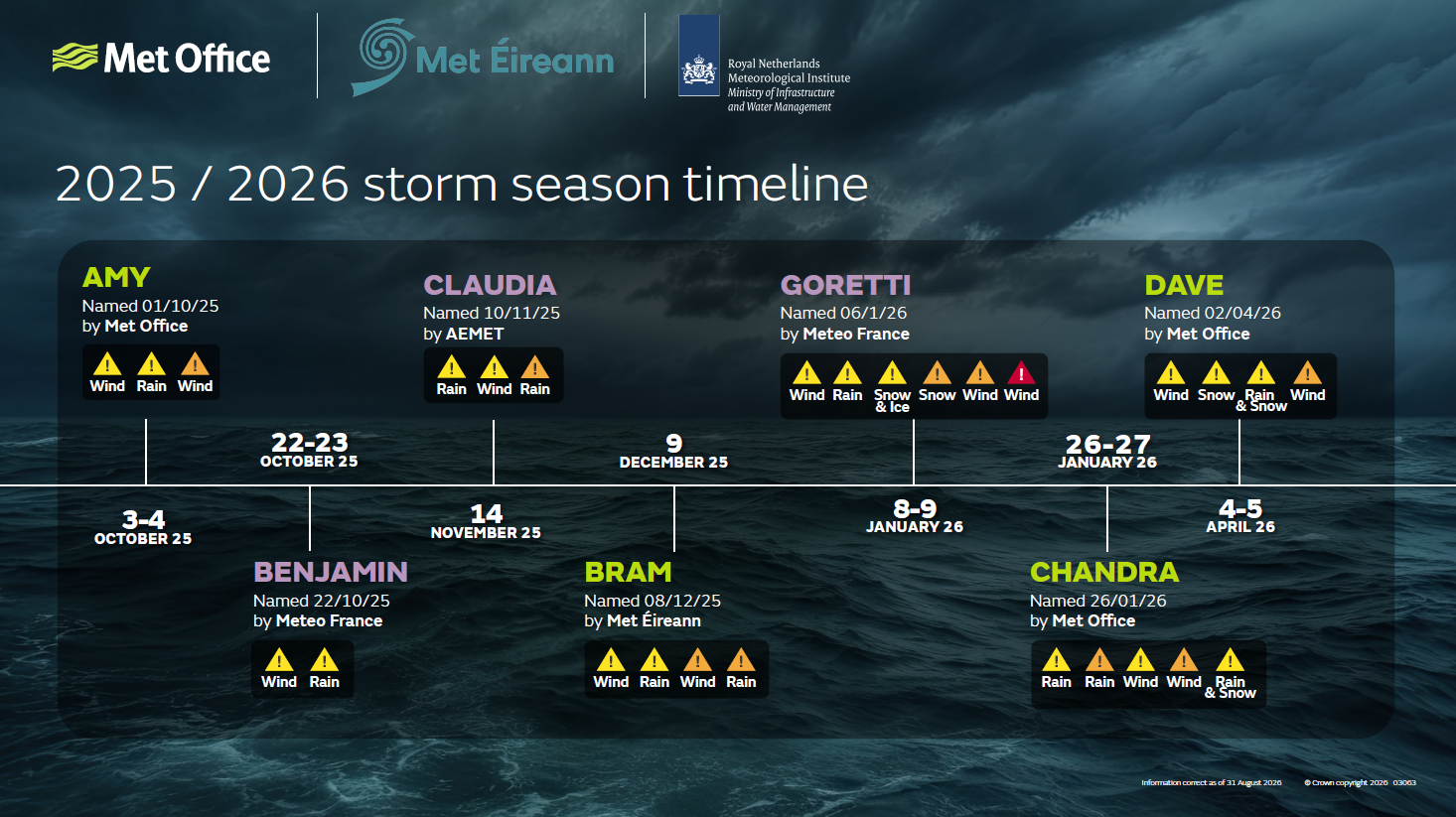
Storm Amy: 3 - 4 October 2025
Storm Amy was the first named storm of the season, hitting north-western parts of the UK. It was an unusually severe, although not unprecedented, storm for the month of October, with wind gusts exceeding 92mph in exposed locations and widespread heavy rainfall.
Storm Benjamin: 22 - 23 October 2025 (named by Météo-France)
Storm Benjamin was named by Météo-France because the greatest impacts were expected across France and the near continent. It also brought strong winds and heavy rain to parts of England and Wales.
Storm Claudia: 14 November 2025 (named by AEMET, Spain’s national meteorological service)
Storm Claudia brought extensive heavy rainfall to England and Wales. Some areas received a month's worth of rain in just six days, with the worst impacts in South Wales. The storm was named by the Spanish meteorological agency, with heavy rain and strong winds affecting Spain and Portugal during the preceding days.
Storm Bram: 8 - 10 December 2025
Storm Bram brought strong winds of more than 60kt (69mph) and heavy rainfall of up to 100mm in some areas, falling on already saturated ground. While notable, it was not considered an exceptional Atlantic winter storm.
READ: Why Storm Bram? Understanding the naming behind the storm
Storm Goretti: 8 - 9 January 2026 (named by Météo-France)
Storm Goretti brought damaging winds to Cornwall and the Isles of Scilly. A gust of 86Kt (99mph) was recorded at St Mary’s Airport, the highest wind speed recorded on the Isles of Scilly for 47 years, and this was one of the most impactful storms to affect the far south-west in recent decades. Goretti was a multi-hazard storm, also bringing widespread lying snow on the northern flank to much of Wales, parts of the West Midlands and the South Pennines.
Storm Chandra: 26 - 27 January 2026
Storm Chandra brought some exceptionally wet weather to parts of south-west England, north-east Scotland and the east of Northern Ireland, with more than 50mm of rain falling widely in the worst affected areas and up to 100mm on higher ground. Chandra formed part of a sequence of low-pressure systems in late January, with the January whole-month average rainfall falling widely across the affected areas in an eight-day period. This contributed to significant flooding particularly across Devon, Cornwall and Dorset.
Storm Dave: 4 - 5 April 2026
Storm Dave brought wet and very windy weather to western and northern parts of the UK, causing travel disruption during the Easter weekend. Winds gusted at over 60kt (69mph) in the worst affected area, including a gust of 81kt (93mph) at Capel Curig in Wales, the highest April gust at this station in a 30-year record. For the UK overall, based on the number of stations exceeding gusts of 50Kt (58mph) or 60Kt (69mph), this was the most severe April windstorm since storm naming was introduced in autumn 2015.
Why did the season only reach ‘D’?
Although we only used four names from our list, the UK also saw impacts from a further three storms named by other European meteorological services.
Storm seasons can be highly variable in the UK. Seasons like 2023/24 – with its record 12 named storms – are exceptionally active, while others, like 2025/26 are quieter. This variability is a normal feature of our climate and doesn’t necessarily reflect long-term trends.
Met Office Scientist Dr Emily Carlisle said: “The number of named storms can vary considerably from one season to the next. Some years bring a succession of impactful storms, while others are much quieter, reflecting the natural variability of the UK’s weather and its position in the North Atlantic storm track.
“A quieter season does not mean there is no risk from severe weather. Even in a year with fewer named storms, an individual event can still bring damaging winds, heavy rainfall, flooding or snow, as several of the storms during 2025/26 demonstrated.”
The Met Office continues to monitor and communicate these events using our National Severe Weather Warnings service, helping the public stay informed and prepared for whatever the season may bring.
Did storm naming help?
Storms are named to raise awareness of severe weather before it hits so people can stay safe. Post-storm surveys show the effectiveness of naming storms to raise awareness.
For Storm Goretti in January 2026, post-event surveys suggest that:
· 93% of people within the amber warning area were aware of the warnings
· 88% of them took action, such as staying in, not driving and shopping early
When and why do we name storms?
Storms are named by Met Office, Met Eireann or KNMI when they are deemed to have the potential to cause ‘medium’ or ‘high’ impacts in one of the countries of the group. This would typically mean an amber or red warning is expected to be issued at some point during the event.
Wind is the primary consideration for naming a storm, but additional impacts from rain or snow are also considered in the naming process. Naming storms helps communicate approaching severe weather clearly, enabling people to prepare and protect themselves, their property and their businesses.
Have UK storms changed due to climate change?
In the recent climate, there is no evidence of positive or negative trends in UK windstorm number or intensity. Trends in windstorm numbers are difficult to detect, due to how these naturally vary year-to-year and decade-to-decade.
In future, most climate projections indicate that winter windstorms will increase slightly in number and intensity over the UK, including disproportionately more severe storms. However, this has medium confidence because a few climate models indicate differently.
This uncertainty highlights the need for ongoing research into how climate change may influence the severity and frequency of windstorms in northern Europe.
An attribution study involving Met Office scientists has shown that climate change has made rainfall during storms more intense through the autumn and winter. This trend is expected to increase further in a warming climate.
Find full scientific reports for each of the season’s named storms in the Met Office’s UK Storm Centre.
Could El Niño make storms worse this season?
El Niño is a naturally occurring climate pattern caused by unusually warm sea surface temperatures in the tropical Pacific Ocean. It can influence weather around the world, although its impacts vary from event to event and depend on how it interacts with other climate drivers.
Current Met Office forecasts indicate that El Niño is strengthening rapidly and could become a very large event. While it is only one factor affecting UK weather, El Niño typically increases the likelihood of wetter and stormier conditions in the UK during late autumn and early winter, though its precise influence on this year's weather will become clearer as forecasts evolve.
READ: An ‘unprecedented’ El Niño and its implications for the weather forecast
Find out storm names for the 2026/27 season on 1 September 2026.