A late-May heatwave may have stolen the weather headlines for Spring 2026, but just how did the weather forecast develop through the season?
May saw daily temperature records set, with 35.1C the new highest figure for the month, set at Kew Gardens. The late-season warmth helped the UK see its third warmest spring on record.
Such was the notable nature of the spring heat, it’s easy to forget that the season also presented other challenges, with Storm Dave being the UK’s most severe April windstorm since storm naming was introduced in 2015.
So, how exactly did the forecast develop through the season (March, April, May), and was the Met Office accurate? Here, we crunch the numbers to find out.
How accurate were the Met Office’s Spring 2026 forecasts?
Met Office forecast accuracy is routinely assessed in a wide variety of ways of ways, but the below figures are informed by forecast verification at around 120 sites around the UK, giving geographical spread across the UK.
Temperature forecasts are deemed to be ‘accurate’ if they’re correct within 2°C of the verifying observation.
1-day maximum temperature forecasts through meteorological spring were 95% accurate, with 77% accuracy at the 5-day range. This element of the forecast is particularly important given the interest in record-breaking temperatures late in the season.
For minimum temperatures, the 1-day forecast was 86% accurate, with this dropping to 59% at the 5-day range.
Wind speed is assessed as accurate if it’s within five knots of the verifying observation and comes into sharp focus during the stormy winter season.
90% of 1-day wind speed forecasts in the season were accurate, with this remaining as high as 81% at the 5-day range.
Wind direction is deemed as accurate if it’s within one compass point on a 16-point compass (22.5 degrees).
Forecasts for this element were 89% accurate at the 1-day range, dropping back to 63% at the 5-day range.
Met Office Chief Meteorologist Will Lang reflected on the season’s forecast accuracy. He said: “We know from our long-term analysis that headline accuracy can be more challenging as we move through spring and towards summer, but we’ve retained our impressive performance well in spring, with the maximum temperature figures particularly notable given the record-breaking heat late in the season.”
Spring’s forecasting skill was underlined by the launch of the Met Office’s most significant scientific upgrade in more than three years, which launched in February.
RNLI Water Safety Manager Sam Hughes said: “Reliable weather forecasts are vital for the RNLI, helping the charity to predict volume and nature of demand for its volunteer lifeboat crews and lifeguards, so they can prepare accordingly to help keep people safe.
“As well as helping our frontline lifesavers, accurate forecasting allows the RNLI to identify periods when those visiting the coast may be at increased risk – for example during stormy conditions or heatwaves – allowing us to share timely and appropriate safety advice, tailored to the conditions, to help save more lives at sea.”
Fewer warnings as settled weather largely dominant
After a meteorological winter which brought a total of 230 National Severe Weather Warnings being issued or amended by the Met Office, spring saw a welcome period of respite in the number of warnings.
Just 24 warnings were issued or amended during meteorological spring, with a month-long period warning free from late-April to late-May.
The relative lack of warnings reflects the conditions observed in the season, which highlights how the weather warning system works; with warnings only issued when impacts are possible. Interestingly, Spring 2025 actually saw even fewer warnings than this year, with just 12 issued or amended.
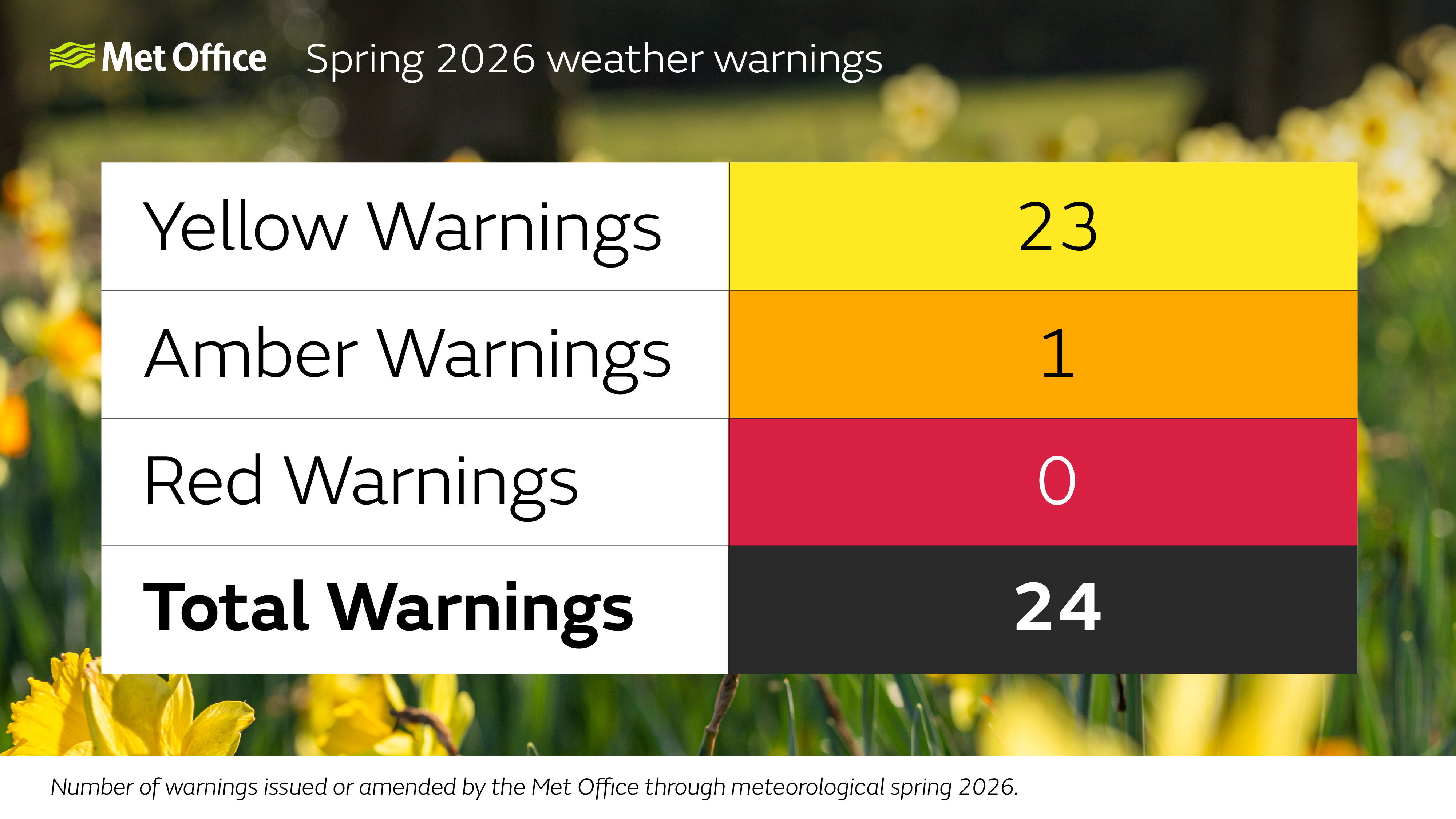
The sole Amber warning this spring was reserved for Storm Dave, which brough a gust of 93mph at Capel Curig, which was the highest April gust at this station in its 30-year record. The initial warning for the strong winds from Storm Dave was issued more than three days ahead of impact, helping aid preparation efforts to keep people safe.
May warmth drives spike in interest in the forecast
While spring delivered just one Amber warning, the unprecedented late-May heatwave was the primary driver of interest in the weather forecast.
Over 225,000 people tuned in to the Met Office’s Week Ahead YouTube video on 25 May, eager for the latest on the heatwave.
Over 11million people tuned in to Met Office forecasts on YouTube alone during the season, with continued popularity for more detailed forecasts available on the platform, such as 10-Day Trend and Deep Dive.
People were also keen to look ahead to sunnier skies in spring, with a post on the daylight hours gained during spring gaining over 5million views on Facebook alone.
Interestingly, on X, the most popular video uploaded during the season wasn’t on the current weather at all, but was instead sharing the trailer for Pressure, an upcoming film which tells the story of the most important weather forecast in history; the D-Day forecast.
The first trailer for ‘Pressure’ is here, the film which tells the story of the most important weather forecast; the D-Day forecast.
— Met Office (@metoffice) March 25, 2026
Andrew Scott stars as Group Captain James Stagg – the Met Office meteorologist tasked with delivering the weather forecast and helping shape… pic.twitter.com/mQ9LLIK462
Over 40million impressions were generated on X alone during the season, with Storm Dave and the late-May heatwave particular highlights.
Nearly 100million web sessions took place on the Met Office website during the season, with 26 May being the most popular day, coinciding with the heatwave forecast.
Over 191million Met Office app sessions took place in the season, with 26 May also proving to be most popular, with 3.9million sessions on the day.