
Artificial intelligence (AI) is accelerating innovation across industries, and weather is no exception. But how can organisations make progress in a way that builds trust, enables collaboration and informs vital decisions?
Weather and climate forecasting is just one of the industries that can be revolutionised by AI and machine learning (ML). An area rich with historical and ongoing trustworthy data; the ingredients in meteorology are present for potentially transformational change in the coming years and increasingly accurate and bespoke forecasts.
Experts on AI, data and technology joined together at Met Office in the Cloud to discuss the future of forecasting, enabling innovation and ultimately informing decision-making across the board.
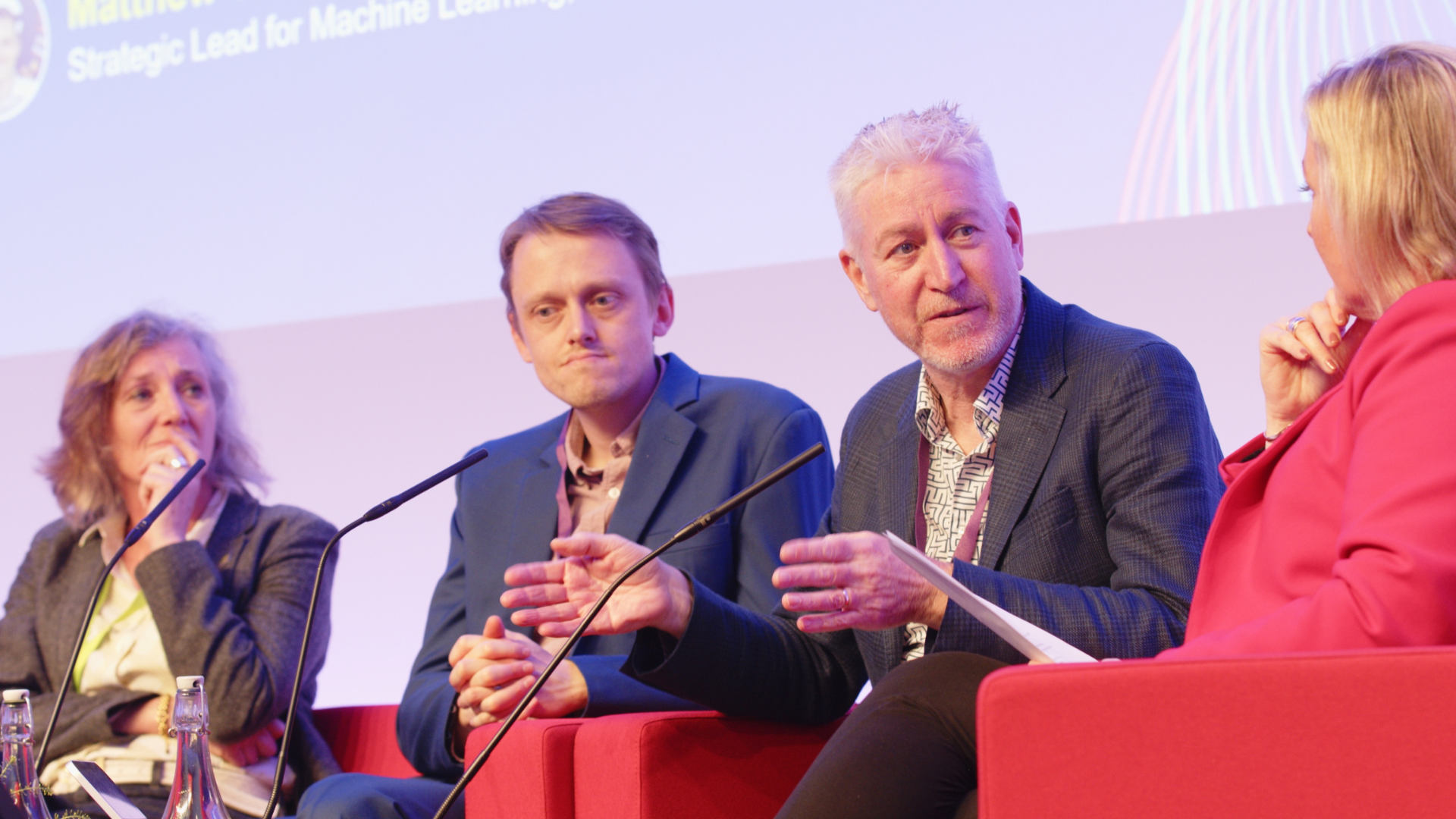
Panelists at Met Office In the Cloud: L-R Kirstine Dale - Chief Artificial Intelligence Officer and Principal Fellow for Data Science at Met Office, Matthew Chantry - Strategic Lead for Machine Learning at ECMWF and Charles Kennelly, Chief Technology Officer, Esri UK
Collaboration the key for future innovation
As experts gathered at Met Office in the Cloud, one key theme from the session was the need for collaboration to enable future benefits for users of weather and climate forecasts.
The Lead for Machine Learning at the European Centre for Medium-Range Forecasts (ECMWF), Dr Matthew Chantry, highlighted how working between organisations has already yielded useful insights.
“AI lets us collaborate at a depth we’ve never had before,” said Matthew.
“Instead of co‑developing a single physics model, we can now co‑design complete AI forecasting frameworks. We’re not aiming for one model. We’re building shared tools, components and benchmarks that accelerate innovation across the community.
“This is exactly what ECMWF was created for, bringing 35 nations together, and the UK is a key partner to push scientific boundaries and ensure that together we lead the next wave of AI-enabled weather prediction.”
The Met Office’s Head of Science Partnerships, Dr George Pankiewicz, also highlighted the importance of collaboration between businesses, government and academics.
He added: “We’ve always relied on contributions from partners around the world. That international collaboration helps make our forecasts more accurate here in the UK.”
Trusting new science
Trust in meteorological science is hard-won, and that wasn’t lost to the contributors on the panel discussion.
As the UK’s national forecaster, trust is central to the Met Office’s mission to help people to stay safe and thrive. New technology doesn’t necessarily undermine that trust, but only if embedded via a robust and authoritative scientific process.
The Met Office’s Chief AI Officer Professor Kirstine Dale said: “Trust is essential. People rely on our warnings, so AI-based forecasts must be verified, transparent and demonstrably fit for purpose before they’re used operationally.”
“Using AI responsibly means empowering people with new tools while maintaining the rigour, testing and verification that underpins trust in our forecasts.”
Matthew added: “We’re developing AI-based forecasting capabilities quickly, but we’re not asking people to abandon what they trust.”
Panellists agreed on the importance of embedding physics-based systems alongside AI in the coming years, enabling the benefits of both approaches to bring maximum impact for users.
From data to decisions
Impact for users is part of the remit of Charles Kennelly, Chief Technology Officer at Esri UK, who, have enabled Met Office Climate Data to be viewed geospatially as part of the Local Authority Climate Service to better inform long-term decision-making.
“Part of our role is to take the Met Office’s data and make it relevant at the point of use,” said Charles.
“We turn forecasts into the insight people need in sectors like utilities, transport and infrastructure.”
“To make data genuinely useful, we have to understand the sector’s real problems. Insight comes from pairing great science with deep knowledge of how organisations actually operate.”
Diversity as a catalyst for innovation
Human expertise remains crucial to future research and forecasting capability, with AI tools likely to accelerate improvements to accuracy and access to information.
What became clear during the panel discussion was the ongoing need for a diverse range of voices helping to build the next generation of AI forecasts.
George said: “Diversity of thinking is hugely powerful in emerging science. Bringing together people from different disciplines and different cultures creates ideas none of us would reach alone.”
Kirstine concluded: “Diversity in every dimension is a catalyst for innovation. To tackle the challenges ahead, we need to make sure everyone who could be part of this journey has the opportunity to contribute.”
The speakers were part of Met Office in the Cloud, a technology event bringing together leaders from industry, academia and government to explore the future of forecasting.