
The Met Office has confirmed a refreshed lineup of leading UK universities for the next phase of the Met Office Academic Partnership (MOAP).
The partnership will continue to bring together world‑class research expertise to advance weather and climate science and support national capability. Seven long‑standing partners, the Universities of Birmingham, Bristol, Edinburgh, Exeter, Leeds, Oxford and Reading, will remain within the partnership. They will be joined by a new member, the University of East Anglia (UEA), recognised globally for its excellence in climate and environmental research.
What is MOAP?
The Met Office Academic Partnership (MOAP) is an established strategic partnership bringing together leading UK universities and the Met Office into an enduring network of research excellence, working together to advance weather and climate science, technology and skill.
MOAP enables collaboration on key areas of science and technology of common interest to the members, this alignment of research effort brings substantial benefits in advancing pioneering science that can be integrated into trusted services.
Partnership aims
The key aims of the partnership are:
- To promote collaborative research throughout the MOAP network, aligning university and Met Office effort to enhance research and innovation in weather and climate science and technology and underpin impactful services
- To invest in the development of the next generation of scientists, technologists and S&T leaders to maintain the UK’s world-leading status in weather and climate science
- To encourage and support proposals for funding and influence priorities for future funding in shared priority weather and climate science and technology areas
- To provide a source of trusted advice and skills to help shape Met Office strategy and support its role as the UK’s National Meteorological Service and national capability in climate science research
A new framework
To support the next four years of collaborative research, the Met Office is launching a second Science Delivery Framework (MOAP SDF2). Starting on 1 April 2026 and running to 2030, the framework will enable our teams at the Met Office to procure specialist research and science services more efficiently across five core capability areas. It also introduces new features, including:
- Co‑sponsorship agreements to support early career researchers and targeted scientific expertise
- Cross‑MOAP competition lot for multidisciplinary or consortium‑based research
Since 2022, the previous Science Delivery Framework delivered nearly 80 research contracts supporting programmes such as the Hadley Centre Climate Programme, NGMS, the Transatlantic Data Science Programme and CCRA4.
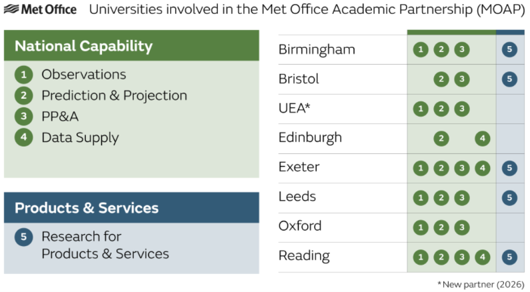
Our partner universities have been selected as preferential suppliers of research services for various capabilities as outlined in the following table:
We acknowledge the valuable contribution of University College London to MOAP over the last few years, whose tenure within MOAP concludes at the end of the current cycle.
Looking ahead
The refreshed partnership marks the beginning of an ambitious new phase of scientific collaboration. Over the coming years, MOAP will continue to drive research excellence and support the UK’s weather and climate priorities.
The strengthened framework will enable new innovation pathways and greater agility in responding to emerging scientific challenges. Together with our academic partners, we look forward to shaping the next generation of environmental science.