Temperatures are rising sharply across the UK, with exceptional and potentially record-breaking heat developing, particularly in southern and eastern areas where values are expected to reach the mid to high 30s.
With a Red Extreme Heat Warning issued for midweek and Amber warnings already in force across much of England and Wales, this is a significant and potentially impactful period of weather.
Episodes like this serve as a reminder that heat can pose a serious risk not only through extreme daytime temperatures, but also through sustained periods of warmth and limited overnight relief.
Understanding how heat risk is communicated is therefore crucial. Two key systems are used here to alert the public and decision-makers: the UK Health Security Agency (UKHSA) Heat Health Alert and the Met Office National Severe Weather Warning Service. While both relate to high temperatures, they serve distinct purposes and are issued based on different criteria.
What is a heat health alert?
The UKHSA Heat Health Alert system is an England only service, designed to highlight the potential impacts of heat on human health, particularly for vulnerable groups. Issued in collaboration with health agencies, it focuses on the cumulative effects of heat rather than just peak daytime temperatures.
Alerts are graded at yellow, amber and red levels, allowing a broader range of potential impacts to be communicated. This means an alert can be issued even when temperatures are not exceptionally high, but conditions are still likely to pose risks.
For example, a prolonged spell of moderately high temperatures can lead to increased health impacts over time. Similarly, very warm nights can reduce the body’s ability to recover, raising the potential for heat-related illness. In such situations, a Heat Health Alert may be issued without a corresponding Met Office extreme heat warning.
READ MORE: How unusual is this week’s extreme heat, and why will it feel so intense?
What is the National Severe Weather Warning Service?
The National Severe Weather Warning Service (NSWWS) is a UK wide service, designed to warn of weather that may cause significant impacts, including disruption to infrastructure, transport and services.
In the context of heat, this includes Extreme Heat warnings, which are typically issued when temperatures and associated impacts reach higher thresholds. An amber warning, for example, signals that widespread impacts are possible, such as strain on infrastructure and increased health risks during the hottest period of the event.
The NSWWS therefore focuses more on the severity and immediacy of impacts, particularly where there is potential for widespread disruption.
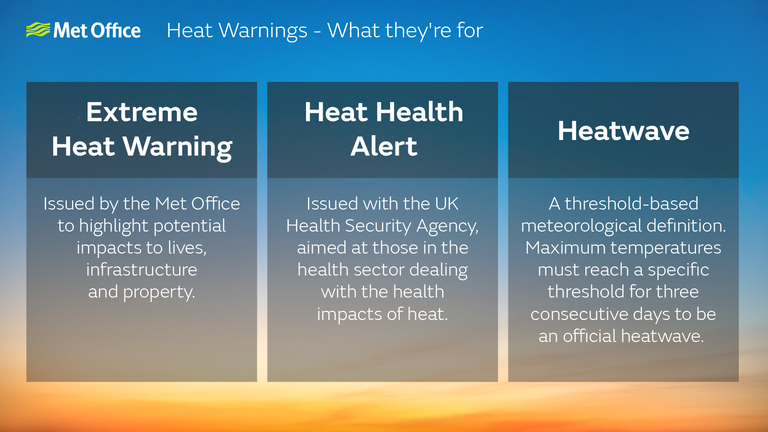
Key differences between the two systems
While both systems relate to heat, the main difference lies in what they are designed to capture.
Heat Health Alerts are centred on public health impacts in England, including the cumulative effects of heat over several days or nights. They can be issued at lower temperatures, reflecting the importance of duration and overnight conditions, not just daytime peaks.
By contrast, NSWWS warnings are issued when the heat is expected to bring clearer risks of widespread disruption across the UK, looking beyond solely health. These warnings are typically tied to likelihood of more immediate impacts.
There is also overlap between the systems. A red Heat Health Alert, indicating a high likelihood of significant health impacts, will almost always coincide with an Extreme Heat warning, reflecting the severity of the conditions.
Defining a Heatwave in the UK
In the UK, a heatwave is officially defined when a location records at least three consecutive days with daily maximum temperatures meeting or exceeding the heatwave temperature threshold. This threshold varies by county, reflecting the diverse climate across the UK.
The Met Office can declare a heatwave during an extended period of hot weather. This is a threshold-based meteorological system which operates independently of any warning system. It is temperature led and does not consider potential impacts from extreme heat on infrastructure, health or people’s lives etc. The Heatwave definition is designed purely to provide the media and public with consistent and reliable messaging. Heatwaves can and will often be declared when no other alerts or warnings have been issued.
READ MORE: UK could see 45°C by 2056, scientists reflect on 1976 heatwave anniversary
Why both systems matter during a heatwave
The ongoing European heatwave illustrates why both alerting systems are essential. High temperatures alone do not tell the full story. The duration of the heat, its geographical spread, and whether there is overnight relief all influence how impacts are felt.
A short, sharp burst of extreme heat may trigger a NSWWS warning, highlighting immediate risks to infrastructure and services. Meanwhile, a longer spell of slightly lower temperatures may still prompt a Heat Health Alert, reflecting the growing strain on public health.
Together, these systems provide a more complete picture of risk. They allow forecasters, emergency planners and the public to understand not just how hot it will be, but how that heat may affect people, services and the wider environment.
Staying informed as heat builds
As temperatures rise across parts of Europe and the UK heatwave develops, keeping up to date with the latest alerts will be important. Whether issued as a Heat Health Alert or an Extreme Heat warning, each type of alert offers valuable information tailored to different aspects of risk.
By understanding the distinction between the two, it becomes easier to interpret the messaging and respond appropriately — whether that means taking steps to protect health during prolonged warmth, or preparing for the more immediate impacts associated with extreme heat.
You can also keep up to date with weather warnings, and find the latest weather forecast on our website, on YouTube, by following us on X and Facebook, as well as on our mobile app which is available for iPhone from the App store and for Android from the Google Play store.